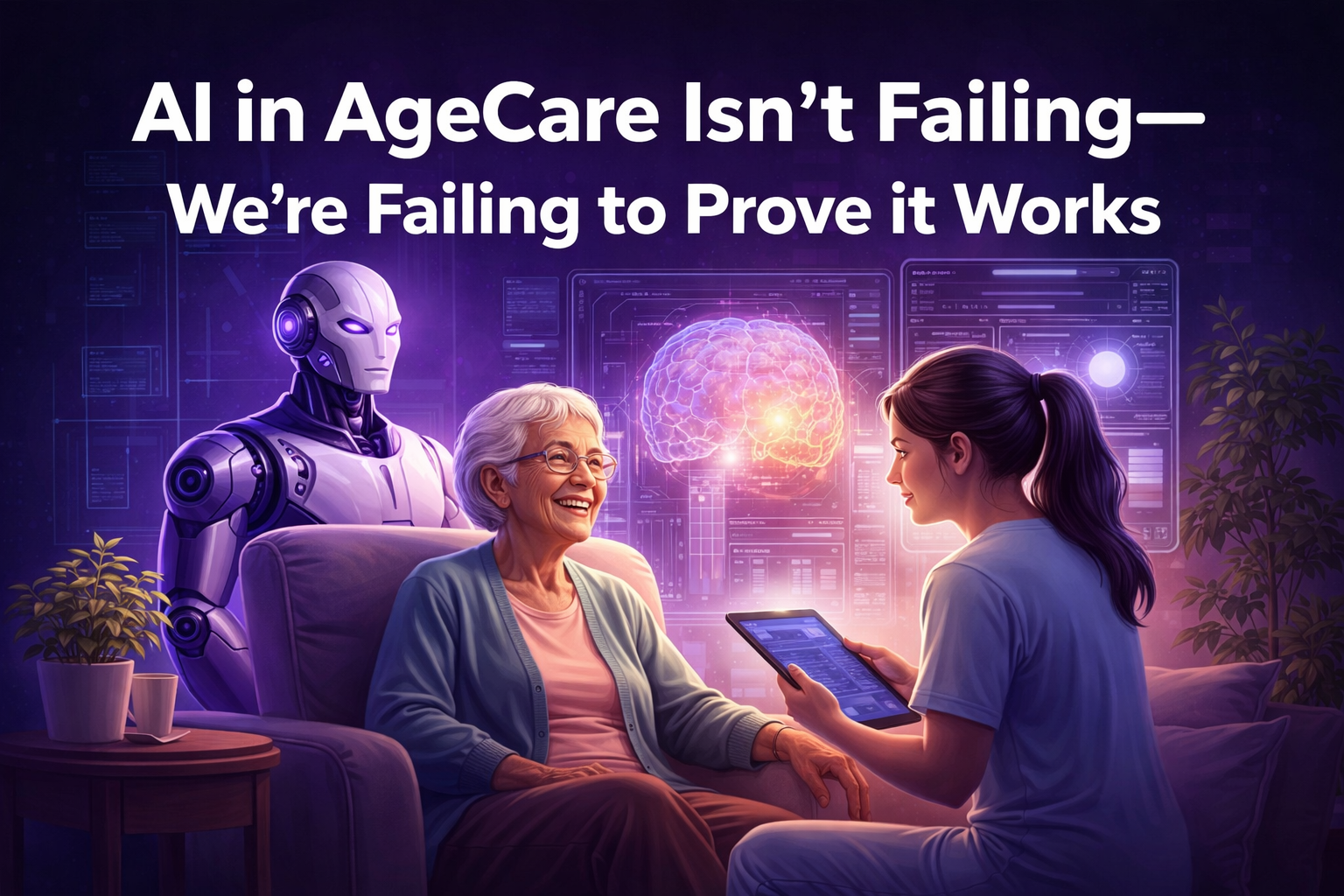
AI in AgeCare isn’t falling short because the technology is weak—
it’s falling short because we never built the systems to prove it works.
The Promise We Bought Into
Why the expectations for AI in aging were so high
Artificial Intelligence was supposed to change how we age.
Not incrementally—but fundamentally.
We imagined a world where risks are predicted before they become emergencies, hospitalizations are prevented instead of managed, and older adults live independently for longer—with dignity.
And on the surface, it feels like we’re getting there.
We now have AI models predicting dementia risk, wearables detecting falls, and systems optimizing care plans in real time.
But inside real-world AgeCare systems, a different story is unfolding.
Quietly, consistently, and systemically—AI is underdelivering.
Not because it can’t work.
But because we haven’t proven that it does.
The Evidence We Can’t Ignore
What recent research is telling us—and why it matters
This isn’t just a perception problem.
Research from The SCAN Foundation (TSF) and CHAI—based on literature reviews, expert interviews, and industry roundtables—points to a deeper structural issue.
Their findings show that:
- many AI tools demonstrate promise but lack real-world validation
- nearly 40% of solutions show no improvement over standard care
- models often fail when applied across diverse older populations
This is the uncomfortable truth:
We are deploying AI into one of the most sensitive areas of healthcare—
without proving it works where it actually matters.
The Illusion of Progress
Why strong performance in labs doesn’t translate to the real world
In controlled environments, AI performs well.
Datasets are clean. Variables are defined. Outcomes are measurable.
But AgeCare doesn’t operate in controlled environments.
It happens:
- in homes, not labs
- across fragmented care systems
- among individuals with vastly different health conditions
- within social and behavioral contexts that data barely captures
The SCAN Foundation highlights a critical gap:
Older adults are highly variable—but AI models are rarely built or validated to reflect that variability.
So when these systems encounter real-world complexity, they struggle.
That’s not a scaling issue.
It’s a validation issue.
We Built Intelligence. We Didn’t Build Assurance.
The industry optimized for capability—but ignored proof
The AI industry has been obsessed with:
- building better models
- increasing accuracy
- scaling data
But it largely ignored a more fundamental question:
How do we prove these systems actually work in the real world?
SCAN’s research reinforces this gap:
- validation is often inconsistent or missing
- external and local testing are rarely embedded into deployment
- performance is not continuously monitored over time
So we end up with systems that look reliable on paper—
but behave unpredictably in practice.
In AgeCare, that’s not just a technical issue.
It’s a human one.
The Data Problem No One Wants to Admit
Why the foundation of AI in AgeCare is fundamentally flawed
Older adults are not a segment.
They are a spectrum.
Yet most AI systems reduce them to a single category: “65+.”
SCAN’s findings make this problem explicit:
- adults aged 85+ are severely underrepresented in datasets
- social, behavioral, and environmental factors are often missing
- definitions of “older adult” vary widely across studies
This leads to biased models, weak predictions, and low clinical confidence.
Because when your data doesn’t reflect reality—
your AI won’t either.
The Missing Standardization Layer
Why the ecosystem is fragmented and impossible to scale
Even if validation improves, another problem remains:
There is no shared foundation.
According to the SCAN–CHAI initiative:
- there is no common data model for aging populations
- no consistent framework for evaluating AI performance
- no standardized definitions of outcomes or endpoints
Every organization defines “working” differently.
Which makes it impossible to:
- compare systems
- trust results
- scale solutions across environments
Without standardization, even good AI looks unreliable.
Trust: The Real Barrier
Why adoption fails even when technology exists
Healthcare runs on trust.
AgeCare depends on it even more.
Families trust systems with loved ones.
Clinicians rely on AI recommendations.
Older adults interact with unfamiliar technologies.
But trust isn’t built on innovation.
It’s built on evidence.
SCAN’s research highlights that adoption barriers are driven by:
- usability challenges
- limited digital access
- lack of transparency and confidence in AI systems
When systems are not explainable or validated, they aren’t debated.
They’re ignored.
And unused AI has zero impact.
The Real Problem
Reframing the failure—this isn’t about AI capability
We didn’t fail at building AI.
We failed at proving it works.
We optimized for:
- innovation
- performance
- capability
But ignored:
- validation
- standardization
- trust
In other words:
We built intelligence.
We didn’t build assurance.
What Needs to Change
The shift required is structural—not incremental
If AI in AgeCare is going to deliver on its promise, the change required isn’t small.
It’s foundational.
1. Validation Must Be Real-World by Design
Models must be tested across diverse environments, continuously evaluated, and locally adapted—not just validated once in controlled settings.
2. Standardization Must Become Infrastructure
We need shared data models, common evaluation frameworks, and standardized definitions of outcomes.
3. Trust Must Be Engineered
Transparency, explainability, and accessible evidence must be built into the system—not added later.
Trust is not a byproduct.
It’s a system.
The Opportunity Most Are Missing
Why this gap creates a new category—not just a problem
This isn’t just a failure.
It’s a massive opportunity.
Because the next generation of winners in AgeTech will not be:
- those with the most advanced models
But:
- those who can prove their models work
- those who can demonstrate safety and fairness
- those who can earn trust at scale
The Missing Layer
What the ecosystem actually needs next
What AgeCare needs isn’t just better AI.
It needs a new layer.
A layer that:
- validates models across real-world conditions
- standardizes how performance is measured
- converts outputs into usable evidence
- enables transparency for clinicians, regulators, and families
A layer that bridges the gap between innovation and adoption.
Final Thought
Where the future will actually be decided
AI has the potential to redefine how we age—making care more proactive, personalized, and humane.
But potential doesn’t create impact.
Proof does.
The future of AI in AgeCare won’t be decided by how intelligent our systems are.
It will be decided by how trustworthy they are.
And right now, that’s the gap we need to close.