Why the future of healthcare AI won’t be decided by better models—but by better proof.
Healthcare AI doesn’t have a model problem. It has a proof problem.
A hospital CIO once told me something simple—but revealing:
“We’ve seen the demos. They’re impressive.
But I don’t know if they’ll work on my patients.”
We’ve built powerful models.
We’ve deployed them across hospitals, clinics, and homes.
We’ve surrounded them with dashboards, metrics, and governance frameworks.
But when a simple question is asked—
“Can you prove this AI works in the real world?”
Most teams don’t have a clear answer.
The Illusion of Maturity
If you look at healthcare AI from the outside, it feels like we’ve arrived.
You’ll hear about systems that can detect cancer early, predict patient deterioration, or assist doctors in making faster decisions.
It sounds—and often looks—like the future is already here.
Behind the scenes, there’s even more:
Teams track performance dashboards.
They monitor drift.
They run explainability tools to understand model behavior.
On paper, everything checks out.
But imagine this:
A model works beautifully in a controlled study…
Then struggles quietly when deployed in a busy hospital with diverse patients, noisy data, and real-world constraints.
That gap between controlled success and real-world reliability is where things start to break.
The Stack We’ve Built—And What It Misses
Today, most healthcare AI systems are built like a well-layered stack.
At the top, you have the Application Layer—the AI making predictions.
Below that, the Metrics Layer—tracking how well it performs.
And then the Policy Layer—ensuring compliance and governance.
Think of it like this:
- The application tells you what the AI is doing
- The metrics tell you how it’s behaving
- The policy layer ensures you’re following the rules
All important.
But here’s what’s missing:
None of these layers can confidently answer—
👉 “Does this actually work for the patients we’re treating today?”
Not in theory.
Not in a test dataset.
But in your hospital, your population, your conditions.
The Evidence Gap
This is where things get uncomfortable.
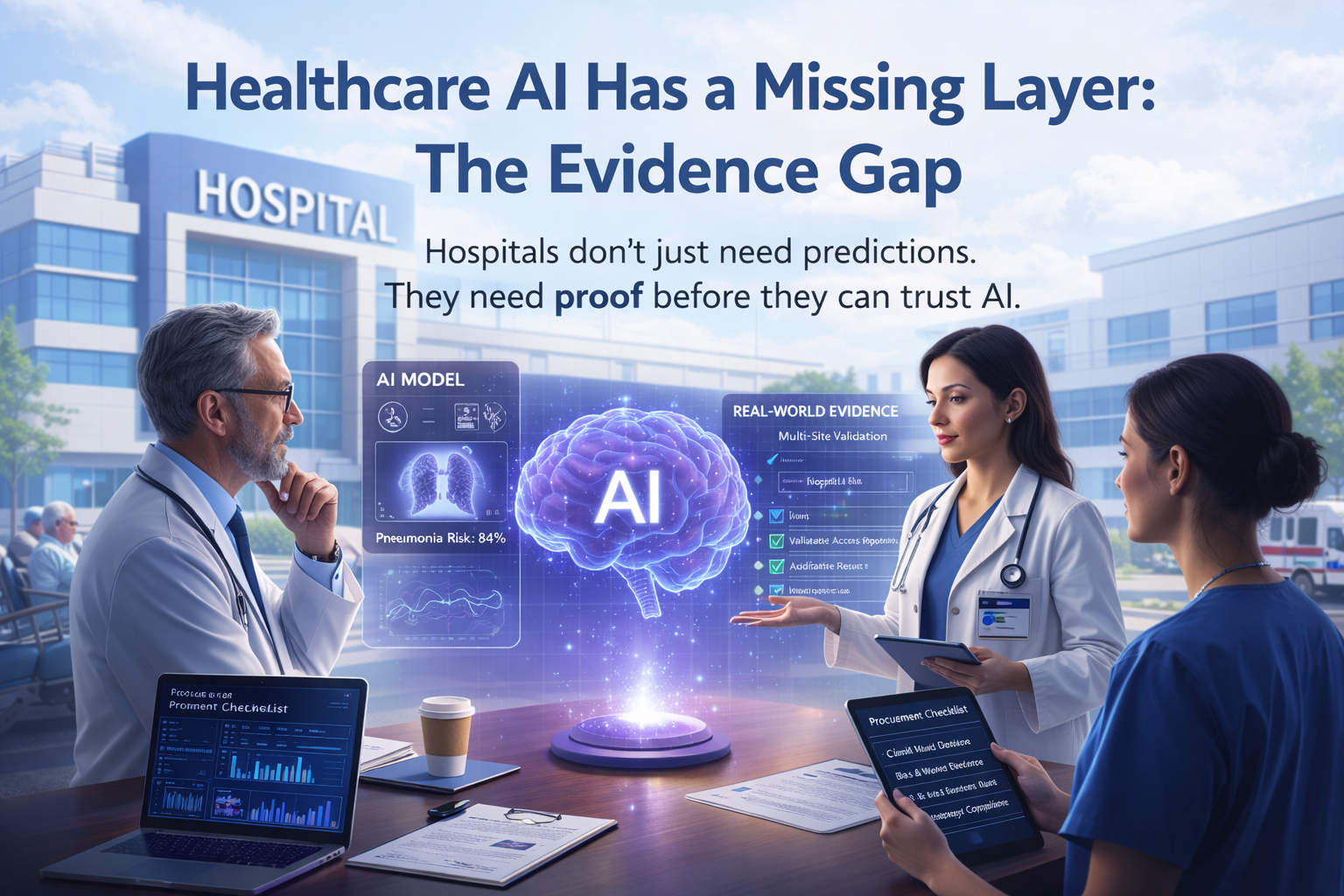
There’s no standard way today to truly validate healthcare AI in the real world.
Imagine two hospitals using the same AI model:
- One serves mostly urban patients
- The other serves rural or elderly populations
Will the model perform the same way in both?
We don’t always know.
And more importantly—
we often can’t prove it in a structured, comparable way.
So instead:
- Models look strong in controlled settings
- Claims are made based on limited validation
- Trust becomes a matter of belief
This is the Evidence Gap.
Not a technical failure—
but a missing layer of proof.
Why This Matters More in Healthcare Than Anywhere Else
In many industries, if AI makes a mistake, it’s frustrating.
In healthcare, it’s personal.
A prediction isn’t just a number—it can influence a diagnosis, a treatment plan, or a critical decision.
And healthcare is messy:
- Patients are different
- Data is inconsistent
- Conditions vary widely
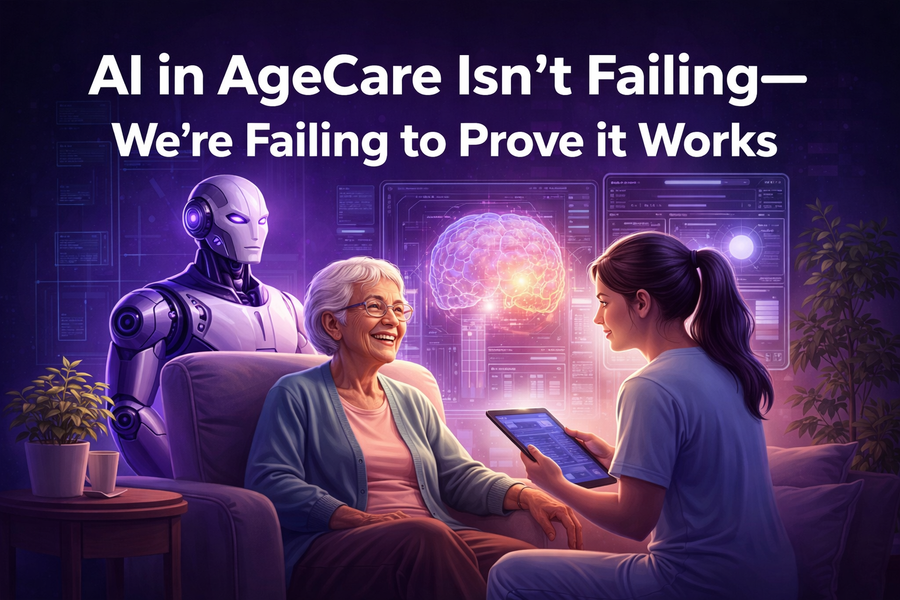
Take AgeCare as an example.
An AI system trained on middle-aged populations may behave very differently when applied to elderly patients with multiple conditions.
Without clear evidence:
- A clinician hesitates: “Can I trust this?”
- A buyer delays: “Is this safe to deploy?”
- A regulator questions: “Where’s the proof?”
The risk isn’t just technical—it’s human.
What Happens Without an Evidence Layer
When we don’t have evidence, we try to compensate.
We build more dashboards.
We generate more reports.
We add more monitoring.
But here’s the problem:
More visibility doesn’t equal more trust.
It’s like having more charts about a patient—but still not knowing if the treatment actually works.
The result?
- AI projects stall after pilots
- Procurement cycles drag on
- Models fail quietly in production
- Trust erodes over time
We end up measuring everything—
except what actually matters.
The Shift: From Monitoring to Proof
The next phase of healthcare AI isn’t about making models smarter.
It’s about making them provable.
Think about how medicine works:
A new drug isn’t trusted because it looks promising.
It’s trusted because it’s been tested, validated, and proven across populations.
Healthcare AI needs the same shift.
We need systems that can:
- Test models in real-world conditions
- Compare performance across populations
- Continuously validate outcomes over time
In short:
We need to move from
“We think it works”
to
“We can prove it works.”
The Missing Layer in the AI Stack
This is where a new idea starts to take shape:
👉 The Evidence Layer
Think of it as the bridge between AI performance and real-world trust.
It doesn’t replace models, metrics, or governance.
It connects them.
It turns:
- Metrics into evidence you can stand behind
- Outputs into artifacts you can audit
- Behavior into claims you can verify
It’s the difference between saying:
“This model has 92% accuracy”
and
“This model has been validated across these populations, in these conditions, with these outcomes.”
What an Evidence Layer Enables
Once you have this layer, things start to change—fast.
- AI teams can demonstrate performance across real populations
- Companies can build trust during enterprise sales conversations
- Regulators can review structured, comparable evidence
- Clinicians can understand when AI is reliable—and when it’s not
Trust becomes tangible.
Not a promise.
Not a slide.
But something you can actually show.
Why This Matters Now
This shift isn’t happening someday—it’s happening now.
Healthcare AI is moving into:
- Higher-risk use cases
- More regulated environments
- More critical decision-making roles
And expectations are rising.
The question is no longer:
“Can you build AI?”
It is:
👉 “Can you prove it works—here, in this setting, for these patients?”
Healthcare Doesn’t Need More AI
It needs AI that can be trusted.
And trust doesn’t come from dashboards.
It doesn’t come from policies.
It comes from evidence.
We’re beginning to see the rise of platforms focused not just on building AI—but on making it provable, auditable, and trustworthy.
Because in healthcare, intelligence is powerful.
But evidence is what makes it usable.