
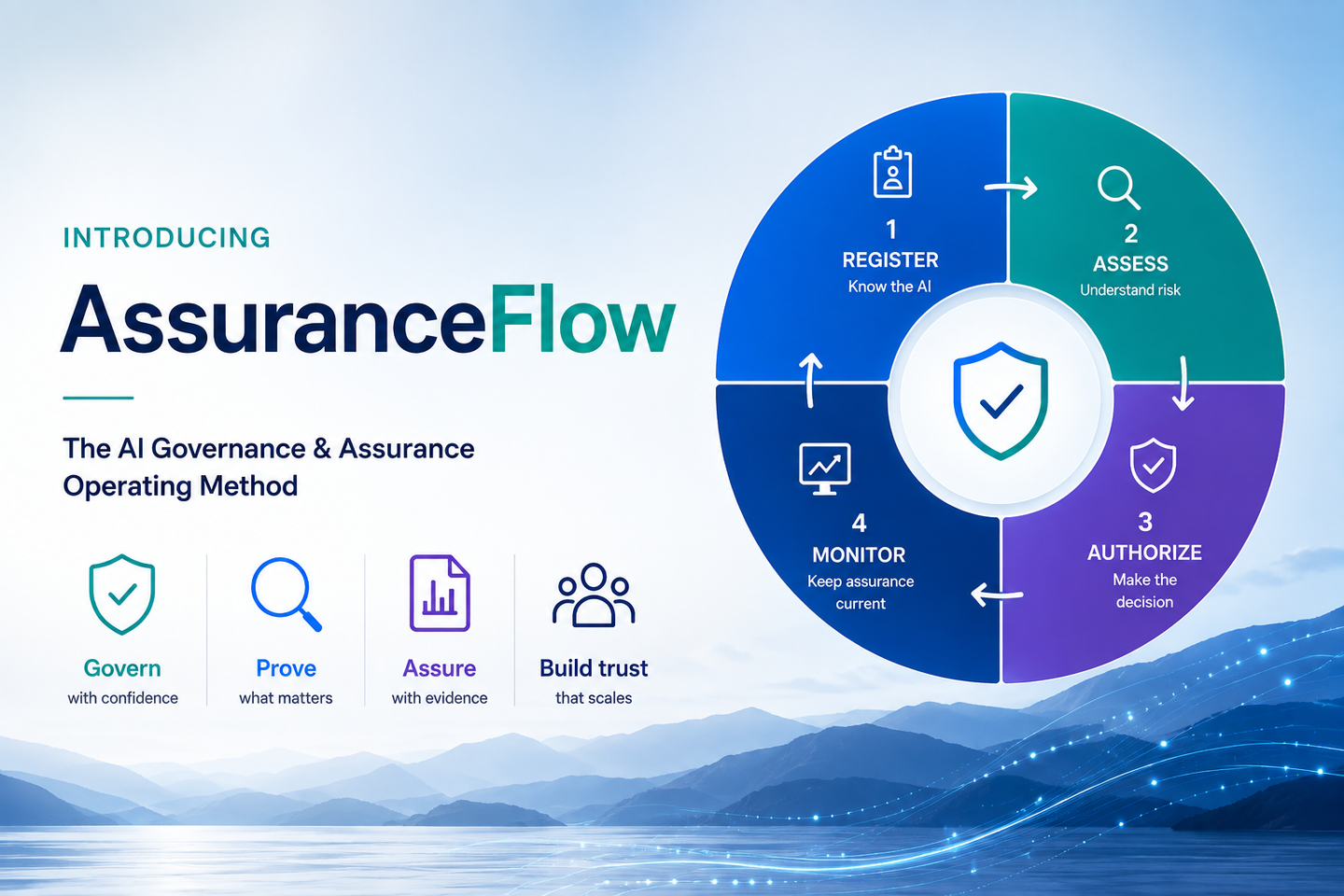
The AI Governance & Assurance Operating Method
A repeatable way to move from AI discovery and risk to evidence-backed assurance, authorization and continuous monitoring.
At some point, every organization deploying AI faces the same question:
Can we trust this AI system to operate?
The question sounds simple.
The answer usually isn't.
The AI system may be registered in one place. Its risk assessment may live somewhere else. Controls may be managed in a GRC platform. Engineering may own model evaluations. Evidence may be sitting in documents and shared folders. Compliance may have the regulatory mapping.
And the final approval?
It may be buried in an email or meeting record.
Everyone has done their job.
But the organization still may not have a single, defensible answer to:
Why is this AI system trusted?
What evidence supports that trust?
Who authorized it?
And is that decision still valid today?
This is where we believe AI governance needs to evolve.
From governance as a collection of activities to assurance as an operating capability.
The Problem Isn't a Lack of AI Governance
Most large organizations are not starting from scratch.
They already have policies.
They have risk frameworks.
They have compliance requirements.
They have control libraries.
They have model evaluation processes.
They may even have AI inventories and AI committees.
The problem is what happens between those activities.
Consider a simple example.
A bank deploys an AI system that reviews mortgage documents and identifies inconsistencies before a loan application proceeds.
The risk team identifies accuracy and fairness risks.
The compliance team identifies applicable requirements.
The governance team defines human-review controls.
Engineering runs model evaluations.
The business owner wants to put the system into production.
Now someone asks:
"Are we ready to approve this?"
Suddenly, the organization needs to connect all those pieces.
Which risk does this evaluation address?
Which control does it support?
What evidence demonstrates that the control is working?
Is the evidence current?
Is the control effective?
What residual risk remains?
Who makes the authorization decision?
That is not simply a documentation problem.
It is an assurance problem.
From Governance to Assurance
We see four distinct questions:
GOVERN
What should be true?
Define policies, controls, guardrails, ownership and oversight.
PROVE
Can we demonstrate it?
Collect relevant, traceable and current evidence.
ASSURE
Is the evidence sufficient to rely on?
Evaluate control effectiveness, residual risk and assurance criteria.
AUTHORIZE
What decision should the organization make?
Approve, approve with conditions, or do not approve.
This distinction is important because having a control is not the same as proving that it works.
And proving that a control works is not the same as authorizing the AI system.
Introducing CognitiveView AssuranceFlow
This is the thinking behind CognitiveView AssuranceFlow.
The idea is deliberately simple:
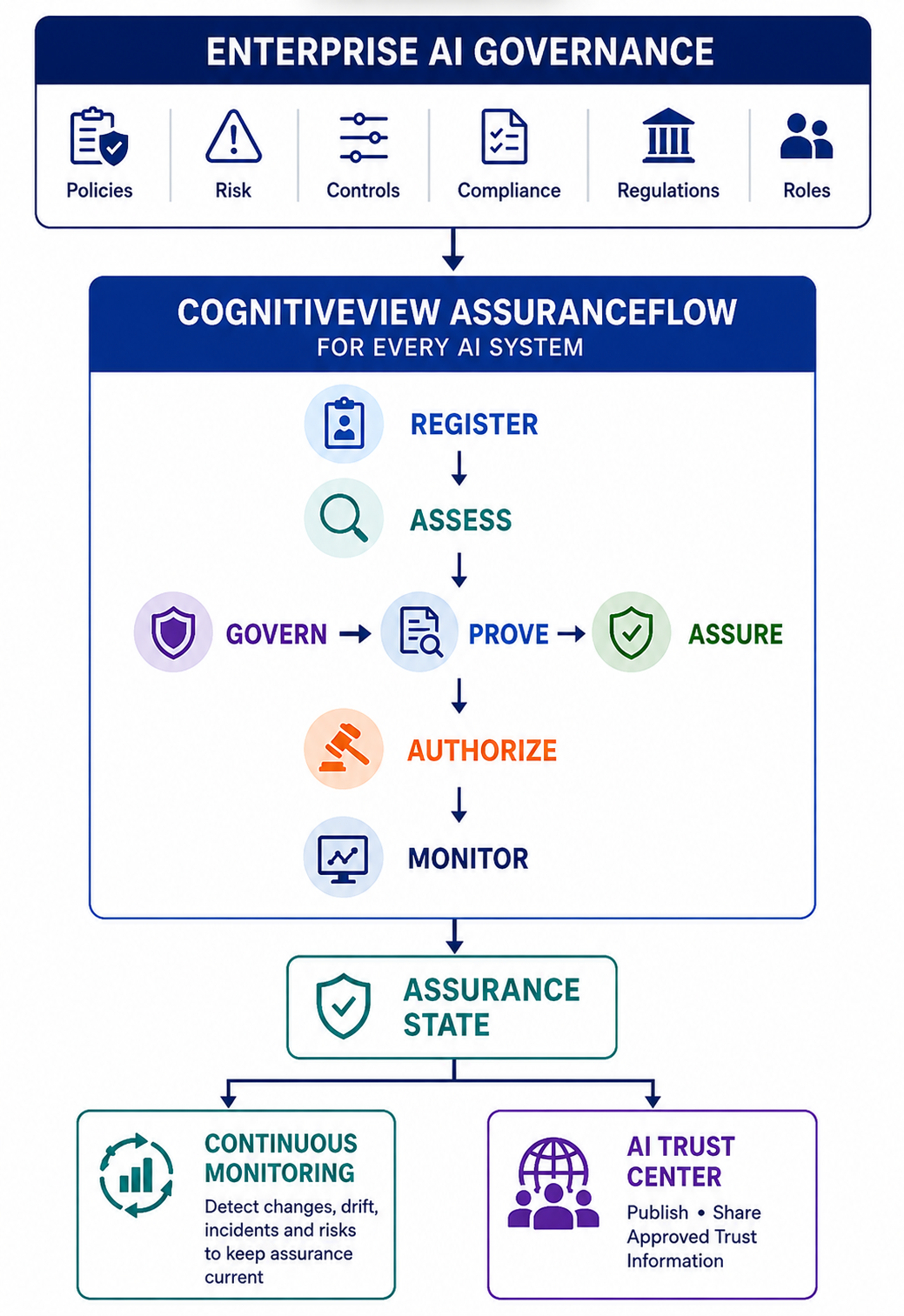
One governance foundation. One AssuranceFlow for every AI system. One continuously maintained assurance state.
Enterprise AI governance establishes the common rules.
AssuranceFlow applies those rules to each AI system.
The resulting Assurance State becomes the current record of that system's governance and assurance posture.
The operating model looks like this:
The customer-facing lifecycle is intentionally simple:
REGISTER → ASSESS → AUTHORIZE → MONITOR
The detailed governance and assurance work happens inside the assessment engine.
That keeps the operating model simple for practitioners without losing the depth required for regulated environments.
1. REGISTER — Know the AI
You cannot effectively govern what you cannot clearly define.
Registration establishes the authoritative record of the AI system.
For our mortgage example, we need to know:
- What is the system designed to do?
- Who owns it?
- Which model does it use?
- What data does it process?
- Does it use agents?
- Who uses its outputs?
- Does its output influence a decision?
- Where is it deployed?
- Is it experimental, in pilot or in production?
The objective isn't simply to create another inventory.
It is to establish the AI System Assurance Record that becomes the foundation for everything that follows.
The practitioner question is:
What exactly are we governing?
2. ASSESS — Understand Readiness and Risk
Once we know what the AI system is, we need to understand what could go wrong.
This is where the AI Readiness Assessment comes in.
It considers:
- AI capabilities
- Intended use
- Business context
- Potential impact
- Inherent risk
- Regulatory requirements
- Required controls
- Guardrails
- Human oversight
- Evaluation requirements
- Evidence requirements
- Applicable frameworks
Return to our mortgage AI.
A model might correctly identify document discrepancies 95% of the time.
That is useful information.
But it doesn't tell us whether:
- high-impact decisions receive human review,
- sensitive information is appropriately handled,
- outputs are explainable,
- decisions are traceable,
- controls are operating,
- or evidence is current.
This is why we separate AI readiness from production authorization.
The assessment establishes what needs to be governed and assured.
It does not automatically approve the AI system.
3. GOVERN — Define What Must Be True
Once the risks are understood, governance turns them into practical requirements.
For our mortgage AI, one control might be:
High-impact discrepancies must receive human validation before an action is taken.
Other controls might address:
- Privacy
- Data quality
- Explainability
- Human oversight
- Security
- Fairness
- Auditability
- Incident management
This is the GOVERN step.
It answers:
What must be true for this AI system to operate within acceptable risk?
But there is an important limitation.
A control in a policy or spreadsheet is still only a statement about what should happen.
We need to prove that it actually happens.
4. PROVE — Show What Is Actually True
This is where assurance starts becoming practical.
For the human-review control, evidence could include:
- Review logs
- Workflow records
- Sampled decisions
- System telemetry
- Exception records
- Evaluation results
Now the question becomes:
Did the required human reviews actually happen?
This is a fundamental distinction:
Governance defines what should be true.
Evidence demonstrates what is true.
Evidence should also be relevant, traceable, sufficient and current.
5. ASSURE — Decide Whether the Evidence Is Enough
Evidence alone isn't assurance.
We need to determine whether the evidence is sufficient to rely on the control.
For example:
The organization requires human review.
The system has review logs.
But are the logs complete?
Did every high-risk case receive review?
Are there unexplained exceptions?
Is the evidence recent?
Is the control actually effective?
This is where ASSURE comes in.
Assurance evaluates:
- Control effectiveness
- Residual risk
- Compliance
- Evidence completeness
- Evidence freshness
- Performance
- Overall assurance status
Performance Is Not Assurance
This distinction is worth making explicit.
Imagine the mortgage AI has excellent accuracy.
It could still fail an important governance requirement.
Perhaps human oversight isn't working.
Perhaps sensitive information is being exposed.
Perhaps the audit trail is incomplete.
Perhaps the evaluation evidence is six months old.
So:
Performance asks:
How well does the AI perform?
Assurance asks:
Do we have sufficient evidence to rely on the required controls?
Authorization asks:
Should the organization allow this AI system to operate?
Three questions.
Three different decisions.
A strong performance score should never automatically override an ineffective mandatory control.
The Assurance Chain
The underlying logic of AssuranceFlow can be expressed as:
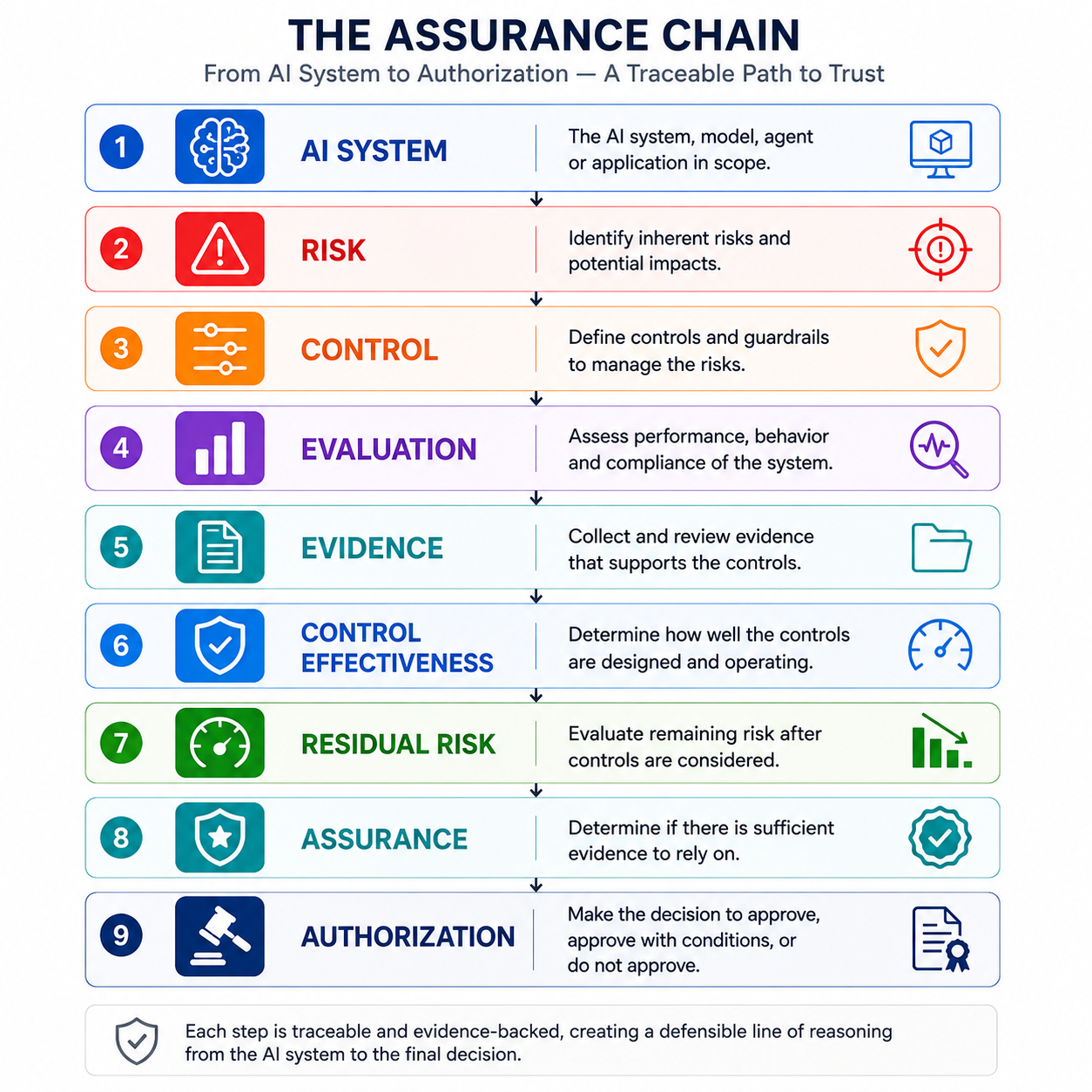
This chain is important because it makes the final decision explainable.
Suppose the mortgage AI is marked NOT READY.
A business executive asks:
Why?
The answer should not be:
"The dashboard is red."
It should be possible to trace the decision:
NOT READY
    ↓
Required control ineffective
    ↓
Evaluation failed
    ↓
Evidence shows threshold breach
    ↓
Control requirement not satisfied
    ↓
Material risk remains
That creates an auditable line of reasoning.
It also makes remediation much clearer.
Instead of asking:
"How do we improve the AI?"
the team can ask:
"Which control failed, why did it fail, and what evidence do we need to demonstrate that it has been fixed?"
That is a much more actionable question.
6. AUTHORIZE — Make the Decision
Assurance establishes the evidence-backed state.
Authorization is the organization's decision.
A practical model is:
READY
The required assurance conditions are satisfied.
READY WITH CONDITIONS
The organization accepts defined gaps under documented conditions.
NOT READY
Required controls or evidence are not satisfactory.
The important point is that CognitiveView does not replace organizational accountability.
The organization remains responsible for authorization and risk acceptance.
Assurance provides the evidence and decision basis.
The authorized decision remains a governance responsibility.
7. MONITOR — Keep Assurance Current
This is where many governance programs struggle.
Approval is often treated as the end of the process.
But AI systems don't stay still.
A model changes.
A dataset changes.
A prompt changes.
An agent gets added.
A vendor changes.
A use case expands.
A regulation changes.
Evidence becomes stale.
So the question becomes:
Is the original assurance decision still valid?
AssuranceFlow therefore treats monitoring as part of the lifecycle.
And importantly, monitoring isn't just about model performance.
It can include:
- Control status
- Evidence freshness
- Drift
- Incidents
- Model changes
- Agent changes
- Dataset changes
- Prompt changes
- Architecture changes
- Vendor changes
- Regulatory changes
- Policy changes
- Remediation
AssuranceFlow Is Change-Driven
Not every change requires starting from the beginning.
A new AI system starts with REGISTER.
A material model change may trigger ASSESS.
A new control requirement may trigger GOVERN.
Stale evidence may trigger PROVE.
A control failure may trigger PROVE / ASSURE.
A material incident may trigger ASSESS / GOVERN.
This gives us a simple principle:
Re-enter where the change matters — not necessarily where the process began.
That is what makes AssuranceFlow a continuous operating method rather than a once-a-year assessment.
The Output Is an Assurance State
This may be the most important idea in the model.
Traditional governance often looks like:
Assess → Report → Approve → Archive
But an AI system doesn't stop changing because a report was completed.
AssuranceFlow instead maintains an Assurance State.
It can tell the organization:
- Current assurance status
- Deployment status
- Control effectiveness
- Residual risk
- Compliance status
- Evidence completeness
- Evidence freshness
- Last assurance date
- Next review
- Reassessment triggers
- Open remediation
So the question changes.
Instead of:
"What did our last assessment say?"
we can ask:
"What is the current assurance state of this AI system?"
That is a much more useful question for an enterprise operating hundreds or thousands of AI systems.
AssuranceFlow and the AI Trust Center
There is another important distinction.
The AI Trust Center is not another step in AssuranceFlow.
AssuranceFlow operates for each AI system.
The AI Trust Center operates for the organization.
AssuranceFlow asks:
Can we trust and authorize this AI system?
The Trust Center asks:
How do we communicate approved trust information to the people who need it?
The Trust Center can present approved information about:
- AI governance
- Policies
- AI systems
- Applicable frameworks
- Compliance
- Human oversight
- Assurance status
- Supporting documentation
The relationship is simple:
AssuranceFlow proves the AI.
The AI Trust Center makes that trust visible.
This separation matters.
The Trust Center should communicate approved assurance information. It should not become a substitute for the assurance process itself.
What Changes for Practitioners?
The practical impact is a change in the questions teams ask.
AI Governance / GRC
Instead of:
"Have we completed the assessment?"
Ask:
"What is the current assurance state?"
Engineering
Instead of:
"Here are our evaluation results."
Ask:
"Which controls do these evaluations provide evidence for?"
Compliance
Instead of:
"The policy addresses this requirement."
Ask:
"What control, evidence and assurance outcome demonstrate that the requirement is being met?"
Business Owner
Instead of:
"Can I deploy the system?"
Ask:
"What conditions apply to authorization, and what could cause that authorization to change?"
Executive / Approval Authority
Instead of:
"Give me the assessment report."
Ask:
"What is the decision, what evidence supports it, what residual risk remains, and what would cause us to revisit it?"
These are much more operational questions.
What Changes for the Enterprise?
Once every AI system follows the same operating method, the organization gains something more valuable than another dashboard.
It gains an AI assurance portfolio.
Leadership can see:
Which systems are READY?
Which are READY WITH CONDITIONS?
Which are NOT READY?
Which controls are failing?
Where is residual risk concentrated?
Which systems have stale evidence?
Which systems need reassessment?
The enterprise can move from managing individual governance projects to managing the current assurance state of its AI portfolio.
What AssuranceFlow Is — and Isn't
AssuranceFlow is not another AI inventory.
The inventory is the starting point.
It is not another risk assessment.
The AI Readiness Assessment is part of the flow.
It is not another model evaluation tool.
Evaluations provide evidence within the assurance process.
It is not simply a compliance checklist.
Compliance requirements become part of the governance and assurance chain.
And it is not simply a dashboard.
The dashboard matters because it represents the underlying assurance state.
The real value is the connection:
Risk → Control → Evaluation → Evidence → Effectiveness → Residual Risk → Assurance → Authorization
That connection is what turns governance activity into an evidence-backed decision process.
The Shift From AI Governance to AI Assurance
The AI governance conversation has evolved.
First we asked:
Do we have an AI policy?
Then:
Do we know what AI systems we have?
Then:
Have we assessed their risks?
Now we need to ask a harder question:
Can we continuously demonstrate that our AI governance is working?
That requires more than policies.
More than assessments.
More than model scores.
It requires a repeatable operating method that connects governance requirements to individual AI systems, controls to evidence, evidence to assurance, and assurance to authorization.
And it requires that assurance to remain current as AI changes.
That is the idea behind CognitiveView AssuranceFlow™.
One governance foundation.
One AssuranceFlow for every AI system.
One continuously maintained assurance state.
The goal isn't to create more governance work.
It is to make the work organizations are already doing connected, traceable and decision-ready.
Because ultimately, the question isn't whether an organization has governed its AI.
The question is much simpler:
Can you show me why this AI system is trusted — and can you prove that the answer is still true today?
That is the shift from AI governance to continuous AI assurance.