Why governance breaks down at runtime—and what needs to change
A few months ago, I was in a conversation with a risk leader at a large enterprise.
They weren’t worried about building AI.
They were worried about living with it.
“Once these agents are in production,” they said, “how do I know what they’re actually doing? And more importantly—how do I prove it later?”
It’s a simple question. But it exposes a deeper gap.
Because most organizations today can see what their systems are doing.
Very few can say whether those systems are behaving as intended—and prove it in a way that stands up to scrutiny.
The Shift: From Models to Agents
For years, governance was built around relatively static systems.
Models were trained, evaluated, and deployed.
You could test them offline. Document them. Review them periodically.
But AI agents don’t behave that way.
They:
- Make decisions dynamically
- Interact with tools and systems
- Adapt based on context
- Operate continuously
Governance, as a result, can’t remain a point-in-time exercise.
It has to become continuous oversight of behavior in motion.
At the same time, expectations are changing.
Frameworks like the EU AI Act, NIST AI RMF, and ISO 42001 are all pushing in the same direction:
- Ongoing monitoring
- Post-deployment accountability
- Evidence-backed compliance
The implication is straightforward:
You can’t govern agents with static processes.
Where Most Organizations Get Stuck
In practice, most enterprises fall into familiar patterns.
Governance lives in documents
Policies exist.
Controls are defined.
But they are disconnected from what the system actually does.
When something goes wrong, teams try to reconstruct behavior after the fact—often under pressure.
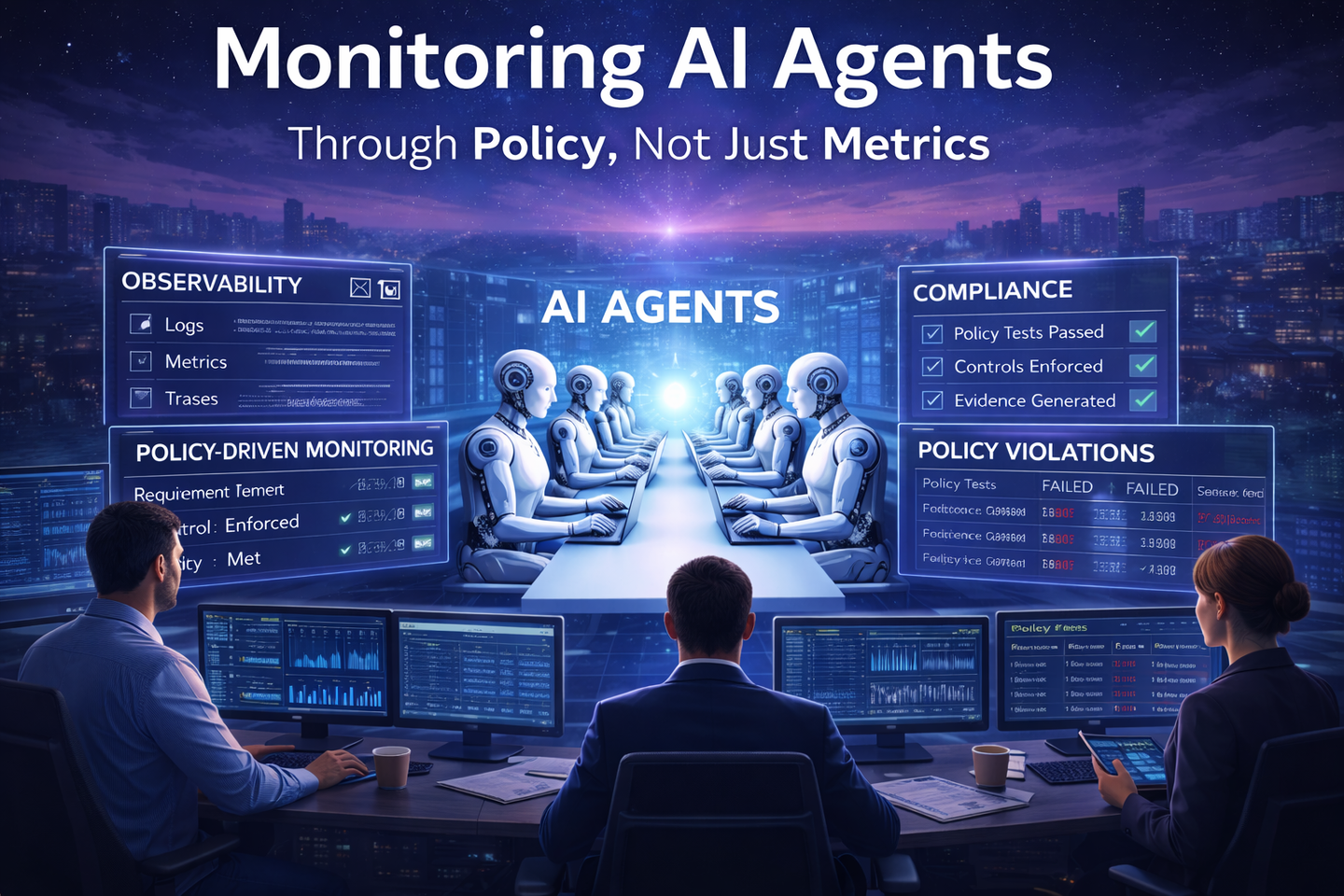
Observability without accountability
Engineering teams invest heavily in monitoring:
- Logs
- Metrics
- Traces
They can answer:
- What happened?
- When did it happen?
But governance questions are different:
- Did the agent follow policy?
- Was a control enforced?
- What evidence supports that?
Those answers are rarely available in a structured, defensible way.
Audit as a retrospective exercise
Evidence is collected manually.
Logs, screenshots, reports—assembled just before an audit.
This approach becomes fragile as systems grow more dynamic and continuous.
These approaches worked when systems were predictable.
They don’t hold when systems are autonomous.
The Missing Link: Policy at Runtime
There’s a deeper disconnect underneath all of this.
Policy and runtime live in separate worlds.
- Policy sits in documents and GRC systems
- Runtime lives in observability and evaluation tools
They rarely connect.
So monitoring tells you what happened.
But not whether what happened was acceptable.
That’s the gap.
Now consider a different approach.
What if you could monitor agents directly through your policies?
Not:
- “Is latency high?”
But:
- “Is the agent operating within defined policy boundaries?”
Not:
- “Did something fail?”
But:
- “Did a control fail?”
This shifts policy from static guidance to an active evaluation layer.
A Different Mental Model
Governance needs to operate as a system, not a process.
A useful way to think about it is:
Policy → Requirement → Control → Test → Evidence → Audit
Not as documentation.
But as a continuous pipeline connected to runtime behavior.
Policies become executable
Policies are broken down into testable requirements.
For example:
- “Model performance must be monitored”
becomes - “Accuracy must be measured every 24 hours”
- “Alert if accuracy drops below 0.85”
These requirements are transparent and reviewable, allowing governance teams to validate how policy is applied in practice.
Policy defines how agents are monitored
Those requirements are not just written.
They are used to monitor agents in production.
Policies define requirements. Requirements map to controls. And those controls are continuously validated through runtime tests.
Every action an agent takes is evaluated against:
- Defined thresholds
- Expected behavior
- Control conditions
In effect:
Your policy becomes your monitoring system.
Runtime behavior is continuously validated
Tests run automatically.
Triggered by time or events.
When an agent acts:
- Its decisions are evaluated
- Its behavior is compared to expectations
- Its outputs are validated
Organizations can choose to:
- Monitor behavior
- Enforce constraints
- Require approvals
Based on risk tolerance.
Telemetry becomes audit-ready evidence
Every agent action generates telemetry:
- What decision was made
- What tools were used
- What context existed
- What checks were applied
This telemetry is structured, linked to policy decisions, and stored as traceable, audit-ready evidence.
Each outcome can be traced from:
- Policy
→ Requirement
→ Control
→ Execution
→ Result
Making decisions explainable and defensible.
Issues are tied back to policy
When something goes wrong, it’s not just a log entry.
It becomes a policy-linked issue.
- A threshold breach becomes a requirement failure
- A missing alert becomes a control failure
Failures are surfaced as issues tied directly to policy and control breakdowns, enabling clear ownership and remediation.
Where needed, exceptions and overrides can be tracked with full visibility and audit trails.
Audit becomes a byproduct
Because everything is:
- Continuously monitored
- Continuously validated
- Continuously linked to policy
Audit readiness is no longer a project.
It becomes a continuous state.
Why Runtime Matters More Than Ever
Most governance conversations still focus on design-time controls.
But with agents, the real risk shows up during execution.
Consider a simple agent:
- It chooses which tool to call
- It decides how to respond
- It adapts based on inputs
The risk is not just in the model.
It’s in:
- Unexpected execution paths
- Tool misuse
- Excessive autonomy
- Behavior under edge conditions
These are behavioral risks.
And they only appear at runtime.
Which raises an important question:
Are you monitoring your systems…
Or are you evaluating whether they are behaving within policy?
What This Means for Leaders
For CIOs, CISOs, CROs, and AI leaders, this shift is practical.
Policies must connect to execution
If policies don’t influence how systems are monitored, they won’t hold up.
They need to define:
- What is measured
- What is acceptable
- What triggers action
Monitoring must be policy-aware
Traditional observability answers:
“What is happening?”
But governance requires:
“Is what’s happening acceptable?”
That requires policy context.
Evidence must be automatic
Manual evidence collection does not scale.
Not when agents are:
- Continuous
- Adaptive
- High-frequency
Evidence needs to be generated as part of execution itself.
Governance becomes event-driven
Instead of periodic reviews:
- Drift triggers re-evaluation
- Failures trigger issues
- Changes trigger new tests
Governance becomes a loop.
Not a checkpoint.
What We’ve Been Building
This shift—from metrics to policy-driven monitoring, from observation to proof—is not theoretical.
It comes from working through these problems in real systems.
Where:
- Policies existed but didn’t influence runtime
- Monitoring existed but didn’t answer governance questions
- Evidence existed, but only after effort
At the same time, teams were already investing in:
- Observability platforms
- Evaluation frameworks
- Agent tooling ecosystems
These systems help teams understand behavior.
They don’t help them govern it.
So we started asking a different question:
What would it look like if there was a runtime governance control plane—a system that connects policy, monitoring, and evidence into a single layer?
Not replacing existing tools.
But working alongside them.
That thinking led us to build a runtime governance control plane for AI agents.
A system where:
- Policies are converted into testable requirements
- Requirements define how agents are monitored in production
- Controls are continuously validated at runtime
- Signals from observability and evaluation tools are ingested and interpreted
- Every decision produces traceable, audit-ready evidence
- Issues, exceptions, and overrides are fully tracked
- And audit readiness becomes a continuous state
In simple terms:
You can monitor your AI agents directly through your policy—using the systems you already have.
Closing Thought
As AI agents become more capable, the question is no longer:
“Can we build this?”
It’s:
“Can we trust it—and prove that we can?”
That proof won’t come from more dashboards.
Or more logs.
It will come from systems where:
- Policies are executable
- Monitoring is policy-driven
- Controls are continuously validated
- Observability and evaluation are connected to governance
- Evidence is automatic and defensible
Because in the end, governance isn’t about observing what happened.
It’s about being able to say—with confidence—
this system behaved exactly as it was supposed to—and we can prove it.