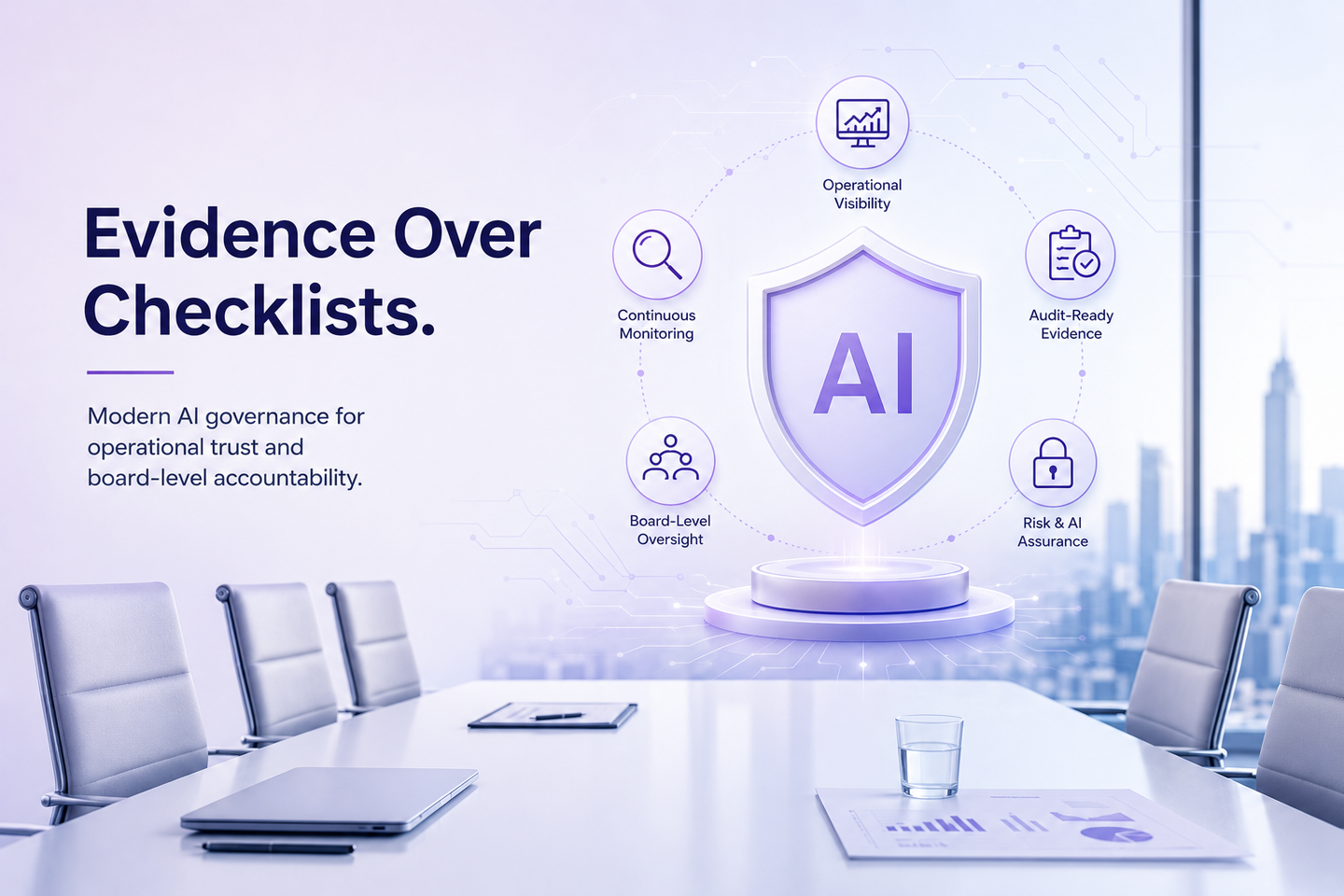
Boards are accelerating AI adoption faster than traditional governance models can adapt — creating a growing demand for operational visibility, continuous monitoring, and audit-ready AI assurance.
Enterprise boards are no longer cautiously observing artificial intelligence from the sidelines.
They are actively pushing executive teams to move faster.
Across industries, AI has rapidly shifted from an experimental technology initiative into a board-level growth mandate tied directly to productivity, competitive positioning, and shareholder value creation.
But beneath the acceleration narrative, a more uncomfortable reality is emerging inside boardrooms.
The systems designed to govern AI risk are struggling to keep pace with the speed and scale of enterprise adoption.
Recent board governance research highlights a growing contradiction:
boards are demanding more AI-driven risk-taking while simultaneously lacking the operational mechanisms needed to confidently oversee those risks.
That tension is beginning to reshape enterprise governance priorities.
Because the issue facing boards is no longer simply whether organizations have AI policies.
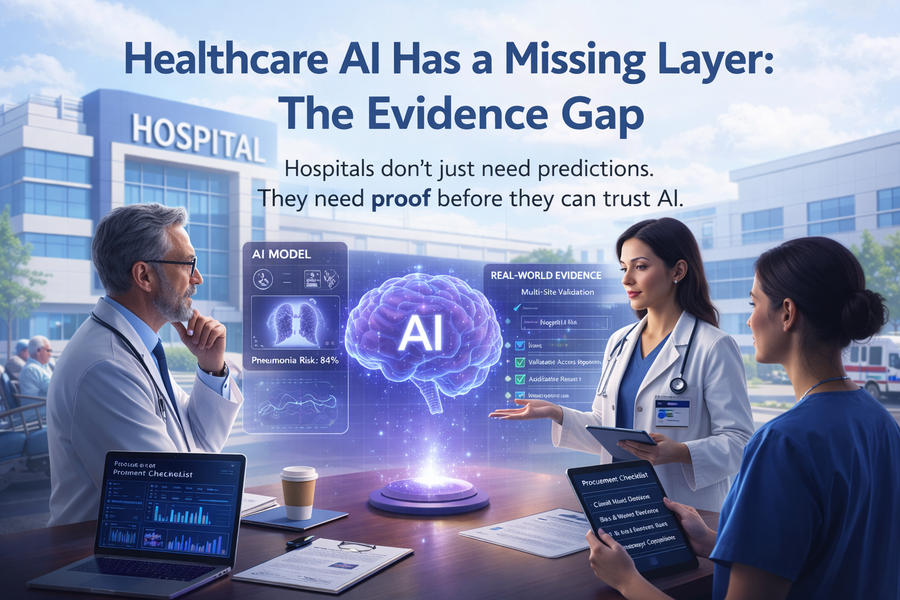
The issue is whether organizations can operationally prove those controls are functioning effectively in dynamic AI environments.
And that is where traditional governance models begin to break down.
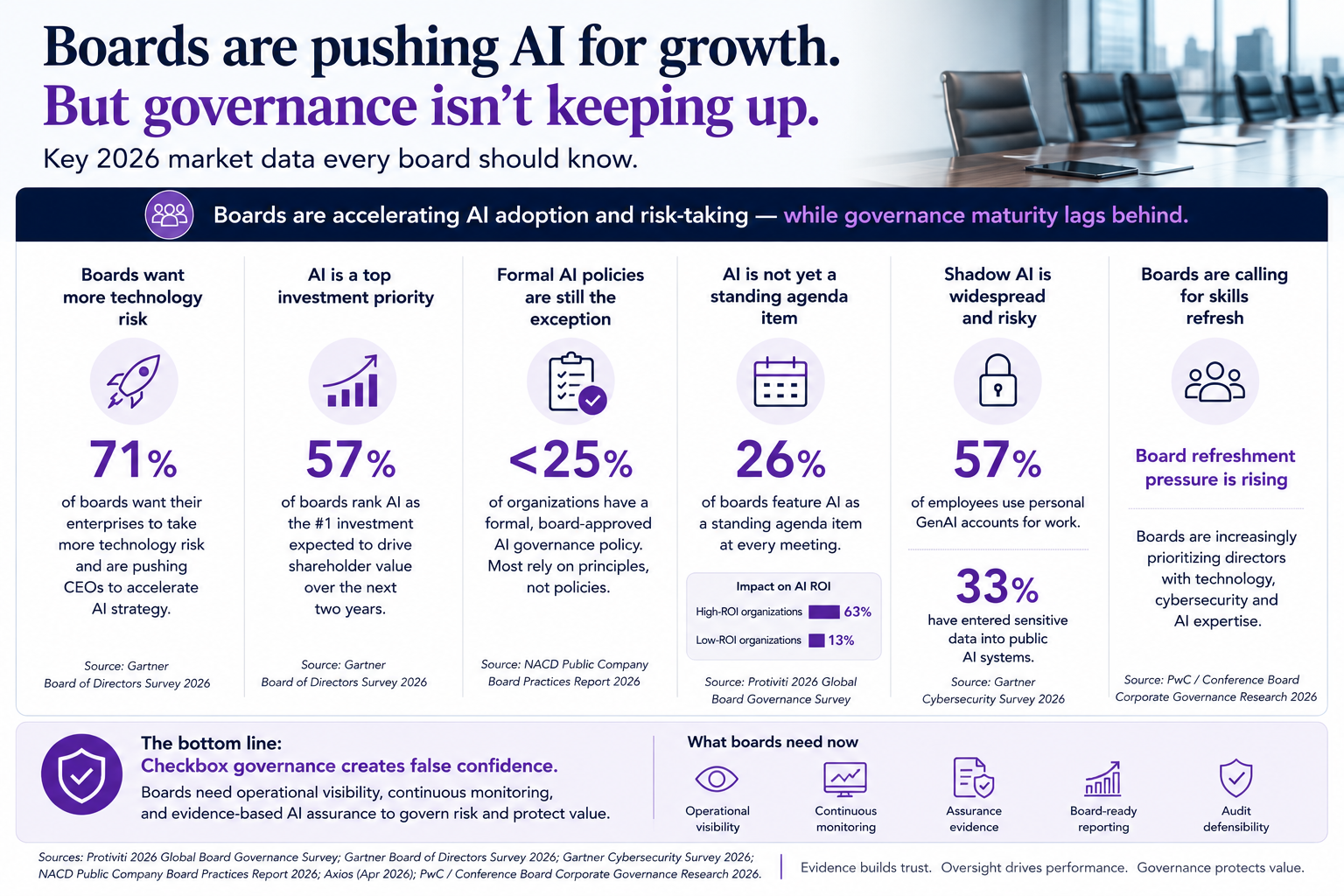
The Boardroom Shift: From Fear of Missing Out to Fear of Losing Control
For the past two years, most enterprise AI conversations were driven by competitive urgency.
Boards feared missing the AI wave.
Today, the conversation has evolved.
The concern is no longer whether organizations should adopt AI. That decision has already been made.
The emerging concern is whether governance maturity is evolving fast enough to manage the operational risks created by that adoption.
This is becoming increasingly visible in boardroom behavior.
AI now appears regularly in board discussions, technology investment priorities continue rising, and executive teams are under mounting pressure to accelerate implementation timelines.
At the same time, many directors privately acknowledge a significant governance confidence gap.
Boards are being asked to oversee:
- rapidly evolving AI systems,
- expanding third-party AI dependencies,
- autonomous decision-making,
- shadow AI adoption,
- and increasingly complex cybersecurity exposure.
Yet many governance reporting structures remain heavily dependent on:
- annual assessments,
- spreadsheets,
- self-attestations,
- interviews,
- and static policy reviews.
The governance model is still largely episodic.
The technology risk environment is continuous.
That mismatch is becoming difficult to ignore.
Governance Documentation Is Not the Same as Governance Assurance
Many organizations have already invested heavily in Responsible AI frameworks.
Policies exist.
Principles statements exist.
Committees exist.
Risk registers exist.
But operational visibility often remains fragmented.
This is one of the most important distinctions emerging in enterprise AI governance:
the difference between governance documentation and governance assurance.
Governance documentation explains what an organization intends to do.
Governance assurance demonstrates whether controls are functioning operationally, continuously, and effectively.
That distinction matters because AI systems behave differently from traditional enterprise software environments.
Their outputs evolve dynamically.
Their risk exposure changes continuously.
Their behavior may shift depending on prompts, training data, integrations, or user interactions.
Static governance processes struggle to keep pace with that level of operational fluidity.
A quarterly governance review may confirm that oversight procedures exist on paper.
It does not necessarily confirm:
- whether monitoring is functioning continuously,
- whether shadow AI usage is expanding,
- whether human oversight controls remain effective,
- whether explainability standards are being validated,
- or whether emerging operational risks are escalating appropriately.
Boards are beginning to recognize this gap.
And many are realizing that governance narratives unsupported by operational evidence create a dangerous form of false confidence.
The Rise of “Checkbox Governance”
One of the more concerning trends in enterprise AI governance is the emergence of what could be described as checkbox governance.
This occurs when organizations focus heavily on governance optics while lacking operational assurance depth.
The symptoms are increasingly familiar:
- AI risk questionnaires completed annually,
- policy attestations signed by business units,
- fragmented AI inventories,
- disconnected monitoring processes,
- manual evidence gathering,
- and governance reporting assembled through spreadsheets shortly before board meetings.
These approaches may satisfy early-stage governance expectations.
They are unlikely to scale effectively in environments where AI systems continuously evolve and operational exposure changes in real time.
The challenge becomes even more serious when boards rely heavily on management summaries without independent operational validation.
As AI adoption expands across the enterprise, governance complexity expands with it.
Boards are now confronting questions that cannot be adequately answered through static reporting alone:
Where are AI systems operating today?
Which systems are considered high impact?
How much shadow AI exists inside the organization?
Can governance controls be independently validated?
How quickly can defensible assurance evidence be produced during an audit, incident, or regulatory review?
Traditional governance workflows were not designed to answer these questions continuously.
That is the governance deficit now emerging across enterprises.
Why This Matters Beyond Compliance
Many organizations still frame AI governance primarily as a regulatory readiness exercise.
That view is rapidly becoming outdated.
AI governance is increasingly becoming an operational resilience issue.
The risk implications now extend far beyond policy compliance:
- cybersecurity exposure,
- data leakage,
- model integrity,
- decision accountability,
- third-party AI dependencies,
- reputational damage,
- and board-level liability.
Generative AI adoption has also significantly expanded enterprise attack surfaces, creating new intersections between cybersecurity governance and AI oversight.
This is forcing boards to think differently about operational trust.
Historically, governance models were largely designed around periodic review cycles.
AI environments do not operate on periodic cycles.
They operate continuously.
That means governance assurance must increasingly become continuous as well.
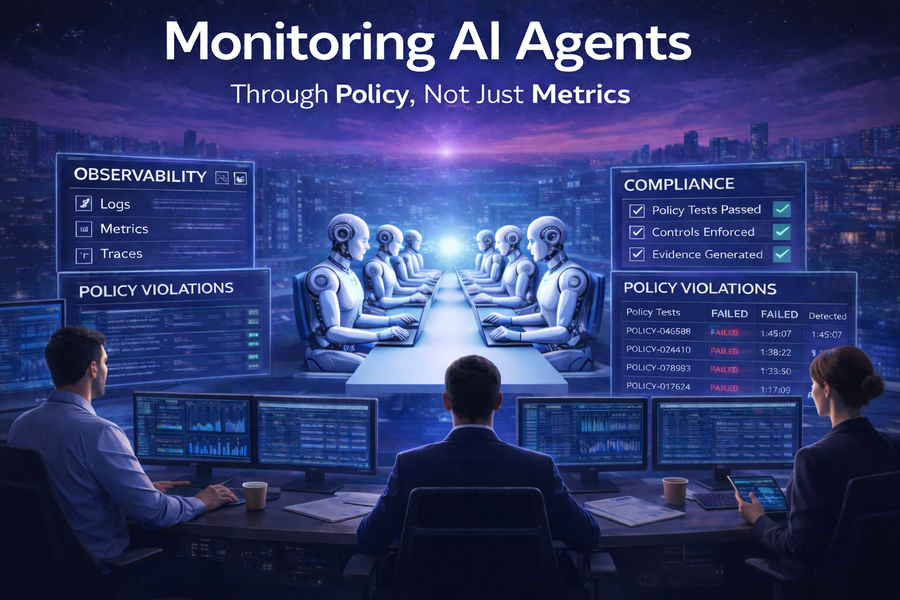
Boards are beginning to expect:
- operational visibility,
- real-time assurance signals,
- measurable governance effectiveness,
- and audit defensibility supported by evidence rather than declarations.
This represents a fundamental governance shift.
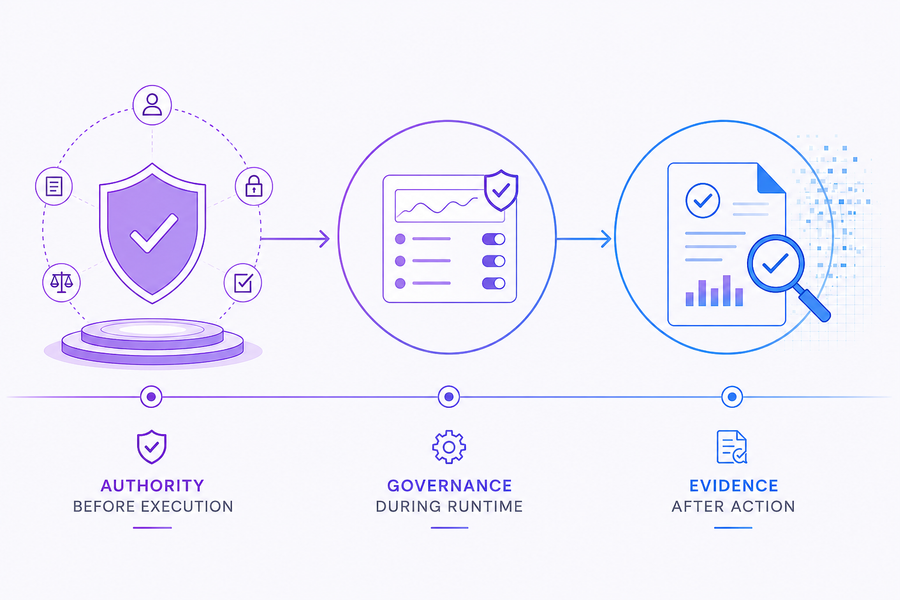
The Emergence of Evidence-Based AI Assurance
The next phase of enterprise AI governance will likely be defined by evidence-based AI assurance.
This is not simply a compliance evolution.
It is an operational transformation in how governance confidence is established.
Evidence-based AI assurance focuses on continuously validating that governance controls are functioning as intended across operational AI environments.
Instead of asking:
“Do we have an AI governance process?”
Boards increasingly need to ask:
“Can we operationally prove governance effectiveness?”
That distinction changes everything.
It shifts governance away from static documentation and toward operational trust verification.
Organizations are beginning to move toward:
- continuous monitoring,
- assurance telemetry,
- operational AI inventories,
- integrated cyber + AI governance,
- explainability validation,
- human oversight measurement,
- and audit-ready evidence generation.
This is where governance maturity is heading.
Not toward more documentation.
Toward measurable operational assurance.
What Modern Board-Level AI Governance Should Look Like
As AI adoption scales, boards will increasingly require governance models built around operational visibility rather than periodic governance narratives.
That means modern AI governance programs will need to provide:
- continuous oversight into AI system activity,
- centralized visibility into enterprise AI deployments,
- integrated cybersecurity and AI risk reporting,
- measurable governance effectiveness indicators,
- board-ready assurance dashboards,
- and operational evidence capable of supporting audit and regulatory scrutiny.
Importantly, boards also need governance reporting that translates technical AI risk into executive-level decision visibility.
Most directors are not asking for deeper technical complexity.
They are asking for greater governance confidence.
They want to understand:
- where material risks exist,
- whether controls are functioning,
- how quickly issues can be escalated,
- and whether the organization can defend its governance posture if challenged.
This is why operational AI assurance is becoming strategically important.
It bridges the growing gap between AI acceleration and governance confidence.
The Future of AI Governance Will Be Operational
The organizations that lead in AI over the next decade will not necessarily be those with the most ambitious AI strategies.
They will be the organizations capable of operationalizing trust at scale.
Because as AI systems become increasingly embedded into enterprise operations, governance cannot remain a static compliance exercise operating on annual review cycles.
Boards are entering a new governance era where:
- operational visibility,
- continuous assurance,
- audit-ready evidence,
- and measurable oversight effectiveness
will increasingly define governance maturity.
The boardroom challenge is no longer simply adopting AI faster.
It is governing AI credibly in environments where risk evolves continuously.
That is why evidence-based AI assurance is rapidly becoming more than a governance enhancement.
It is becoming a foundational requirement for enterprise AI trust.