
An AI system makes a wrong decision.
A customer is denied a loan. A patient receives an incorrect recommendation. A hiring candidate is unfairly filtered out.
A regulator steps in. Questions are asked.
No one asks, “Were you ISO 42001 compliant?”
They ask:
“Why did you approve this—and what evidence did you have at the time?”
That question changes everything.
The Comfortable Illusion of Being “Covered”
Most organizations today feel reasonably confident about their AI governance.
They have:
- Responsible AI policies
- Risk assessments and impact analyses
- Compliance mappings to frameworks like ISO 42001 or NIST
- Internal audits and documentation
From the outside—and even internally—this looks solid.
There is structure. There are processes. There is documentation.
And all of this is necessary.
But here’s the subtle problem:
👉 These efforts create a sense of control, not necessarily actual decision clarity.
Consider this scenario:
A credit risk model is reviewed.
- Bias is assessed ✔
- Documentation is complete ✔
- Controls are listed ✔
But when asked:
“Should we deploy this model now?”
The answer is:
- “It depends…”
- “We need more discussion…”
- or worse—no clear answer at all
That’s where governance quietly breaks down.
Where AI Governance Actually Breaks
The issue isn’t that organizations don’t understand risk.
It’s that the process does not culminate in a clear, accountable decision.
In real-world environments:
- Risks are identified, but not explicitly accepted or rejected
- Controls are defined, but not validated in real operating conditions
- Evidence exists, but is fragmented across tools and teams
- Decisions are implied through progress—not formally made
For example:
An AI model moves from testing → staging → production
Not because someone explicitly approved it, but because:
- “no blockers were raised”
- “everything looked okay”
That is not a decision. That is default progression.
And that’s dangerous.
👉 Because when something goes wrong, the question becomes:
“Who approved this—and based on what?”
If that answer is unclear, governance collapses under scrutiny.
What ISO 42001 Actually Does—And Where It Stops
ISO 42001 plays an important role in this ecosystem.
It provides:
- A structured approach to AI governance
- Defined processes for risk management
- Documentation and control requirements
- Organizational accountability frameworks
This is foundational. Without it, governance becomes inconsistent and unreliable.
But ISO 42001 is a management system standard—not a decision framework.
It ensures you:
- have a process
- follow that process
- document that process
It does not determine:
- Whether a specific AI system is safe to deploy today
- What level of risk is acceptable in a given context
- Whether the available evidence is sufficient
- Whether controls are actually effective in practice
Example:
Two organizations may both be ISO-aligned.
- Organization A documents bias testing
- Organization B documents bias testing
Both are compliant.
But:
- Organization A validates results with real-world monitoring
- Organization B relies only on offline metrics
ISO treats both as aligned.
But from a decision standpoint, they are not equally defensible.
ISO ensures you have a system.
It does not make—or validate—the decision.
The Missing Layer: Defensibility
When AI decisions are challenged, the evaluation shifts.
It’s no longer:
- “Did you follow a process?”
It becomes:
- “Can you justify your decision?”
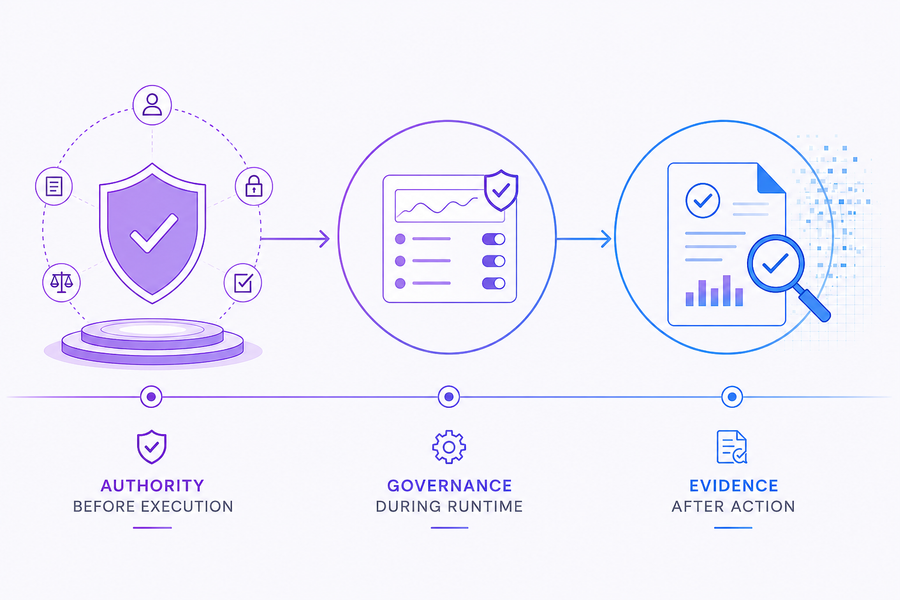
Defensibility means you can clearly demonstrate:
- What you knew at the time of approval
- What risks were identified and understood
- What controls were implemented and tested
- What evidence supported your confidence
- Who took responsibility for the decision
Scenario:
A fraud detection model blocks legitimate users.
A regulator asks:
- Why was this threshold chosen?
- What testing supported it?
- Was there monitoring in place?
If your answer is:
- “We followed our policy”
That’s weak.
If your answer is:
- “We tested across X datasets, observed Y false positive rate, implemented monitoring, and accepted residual risk under defined thresholds approved by [role]”
👉 That is defensible.
Why This Gap Is Becoming Critical
AI is now embedded in high-impact environments:
- Financial decisions (credit, fraud, underwriting)
- Healthcare recommendations
- Hiring and workforce management
- Customer experience and personalization
These are not low-risk systems.
When failures occur:
- They affect real people
- They attract regulatory attention
- They escalate quickly
And in those moments:
- Policies don’t protect you
- Framework alignment doesn’t protect you
👉 Only clear, evidence-backed decisions do
What the Board Actually Wants to Know
At the executive and board level, the conversation is very different.
They are not asking:
- “Are we ISO aligned?”
They are asking:
- Why did we approve this system?
- What evidence did we rely on?
- What risks are we accepting?
- What happens if we are wrong?
- Who is accountable?
Example:
Before deploying an AI system in a high-risk use case, a board doesn’t want:
- 50-page documentation
They want:
- A clear summary
- A risk position
- A confidence level
- A decision recommendation
👉 In other words: decision clarity, not documentation depth
The Shift: From Compliance to Decision
This is where organizations need to evolve.
From:
- policy → proof
- risk identification → risk acceptance
- compliance → defensibility
This introduces a new layer:
👉 AI readiness as a decision model
AI readiness is not:
- a checklist
- a maturity score
- a compliance badge
It is:
👉 A structured, evidence-backed answer to:
“Should this system go live right now?”
With explicit outcomes:
- Approved
- Conditionally approved
- Not approved
What Good Looks Like
A defensible AI decision has specific characteristics.
It includes:
- A clearly defined use case and boundaries
- Identified and accountable decision owner
- Risks that are explicitly evaluated—not just listed
- Controls that are tested—not just described
- Evidence that is current—not retrospective
- A clear decision with rationale
Example:
Instead of:
- “Bias risk assessed”
You have:
- “Bias evaluated across demographic segments, disparity within acceptable threshold (X%), monitored post-deployment”
That difference is everything.
Final Thought
ISO 42001 helps you prepare.
It gives you structure, process, and governance discipline.
But when something goes wrong, preparation is not what’s evaluated.
Your decision is.
And the only question that matters is:
Can you defend it?