
Why financial institutions need governance that operates at the point of action — not only before deployment or after an incident
AI governance is entering a new phase
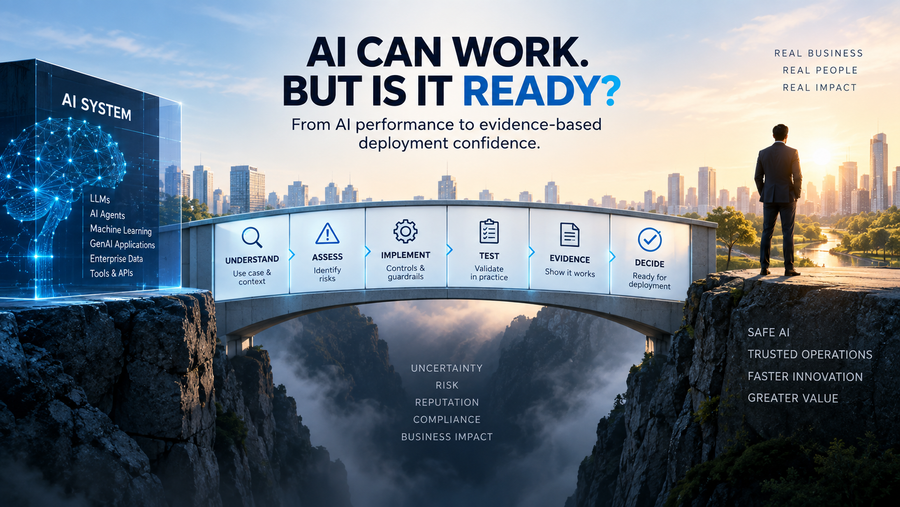
For years, enterprise AI governance has focused on a relatively straightforward question:
Is this AI system ready to be deployed?
Organisations assess the use case, identify risks, define policies, assign ownership, establish controls and determine whether the system can move into production.
That model works well when AI primarily supports human decisions.
But agentic AI changes the operating model.
An AI agent can plan, use tools, interact with systems and initiate actions with limited or no human intervention at each step. In financial services, those actions can include initiating payments, submitting trades, supporting credit processes, triggering compliance workflows or interacting with downstream financial systems. The SAFR paper identifies this transition from recommendation to execution as a fundamental change in the risk and governance problem.
The question therefore changes.
It is no longer enough to ask:
"Is this agent approved?"
We also need to ask:
"Is this agent authorised to take this action, under these conditions, right now?"
That is the runtime governance problem.
The missing layer: between decision and execution
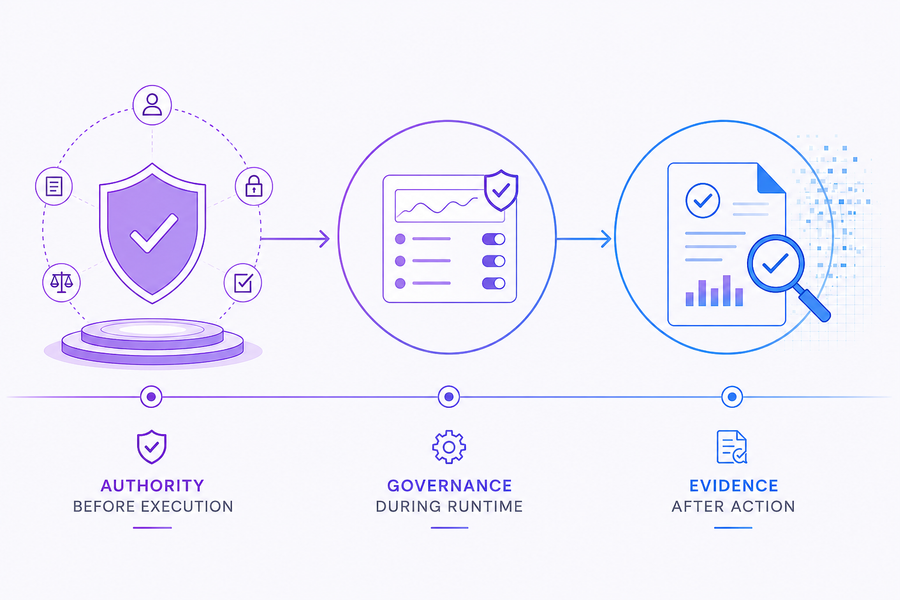
Traditional governance operates primarily at the system, model and policy level.
Runtime governance operates at the action level.
The distinction is important.
An agent may be approved to support payments.
That does not mean it should be able to initiate every payment.
An agent may have access to a trading system.
That does not mean every trade is within its authority.
An agent may be authorised to perform a compliance workflow.
That does not mean it can bypass a required human approval.
The SAFR approach addresses this by introducing a governance checkpoint between an agent's decision and its execution. The framework defines four core runtime components:
- Agent Identity
- Controls Repository
- Disposition Engine
- Audit Log
These components operate through a Governance Envelope containing the proposed action, action trace and relevant context.
The architectural idea is simple:
AI Agent → Runtime Governance → Execution
Instead of allowing an agent's decision to flow directly into an operational system, the proposed action passes through a governance layer first.
Why this matters particularly in financial services
Financial actions are different from ordinary AI outputs.
A generated summary can be reviewed and corrected.
A financial transaction may already have moved money.
A trading decision may affect a position.
A regulatory filing may create a formal obligation.
A customer action may have legal or economic consequences.
And autonomous systems can perform these actions at machine speed.
The SAFR paper identifies three important gaps in existing governance approaches:
Pre-execution assurance.
Traditional model validation happens before deployment, while traditional audit is often retrospective. Neither necessarily evaluates the specific decision immediately before execution.
Human-agent governance.
Simply sending an alert to a human does not necessarily constitute effective human oversight. Escalation needs defined authority, timing and accountability.
Fragmentation.
Agent-specific controls can become isolated and inconsistent across deployments.
This leads to a simple principle:
When AI can act autonomously, governance must operate at the speed and level of the action.
From policy documents to executable controls
This is perhaps the most important shift.
Consider a policy stating:
An agent must not execute transactions above its delegated authority.
That is a governance requirement.
But runtime governance needs to turn that requirement into something executable.
For example:
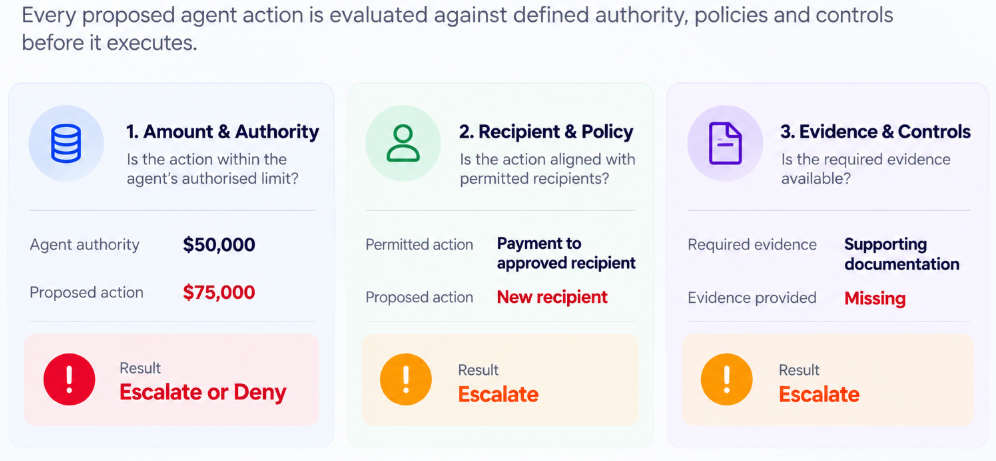
The SAFR Controls Repository is designed to hold these types of controls, drawing from organisational policies, regulatory requirements, product rules and delegated authority. Controls can include authorisation, exposure limits, rate limits and evidence-quality requirements.
This is the difference between having a policy and enforcing a policy when an agent acts.
Four possible outcomes — not just "allow" or "block"
Another important characteristic of runtime governance is that not every action needs the same treatment.
SAFR defines four dispositions:
Auto-Execute
The action is within the agent's authority and defined risk thresholds and can proceed without human intervention.
Observe
The action can proceed, but the event is flagged for monitoring.
Escalate
The action requires human review before proceeding.
Deny
The action violates a defined constraint or exceeds the permitted risk boundary and is rejected.
This creates a more nuanced governance model.
The objective is not to put a human in front of every AI action.
Nor is it to allow every action to proceed autonomously.
It is to establish appropriate autonomy for the risk of the action.
The human is still part of the control system
Agentic AI does not eliminate human accountability.
It changes where human involvement happens.
A well-designed runtime governance model can allow low-risk actions to proceed automatically while routing higher-risk actions to authorised reviewers.
But escalation itself needs governance.
Who reviews the action?
How much time do they have?
What authority do they have?
What happens if they do not respond?
The SAFR paper explicitly highlights escalation volume, review turnaround and reviewer authority as important considerations.
This is an important distinction:
Human-in-the-loop should not mean human-as-notification-service.
For oversight to be meaningful, the human needs the information, authority and time necessary to make the decision.
Every action should leave evidence
Runtime governance also changes the role of audit.
Instead of trying to reconstruct what happened after an incident, the governance process can create evidence when the decision happens.
SAFR's Audit Log is designed as a tamper-evident record of the governance decision, including the submitted Governance Envelope, mandate, outcome, rules applied, basis for the decision and timing.
This creates a valuable chain of accountability:
What did the agent propose?
Who was the agent?
What authority did it have?
Which controls applied?
What decision was made?
Why?
Was human intervention required?
What happened next?
That evidence can then support operational oversight, compliance review, audit and remediation.
Where CognitiveView fits
CognitiveView's approach is to connect enterprise AI governance with runtime agent governance.
Our AI Assurance & Control Plane provides the governance foundation required before an agent reaches the point of action:
Discover → Assess → Govern → Authorize
Then the runtime layer takes over:
Proposed Action → Governance Gateway → Decision → Outcome → Evidence
The CognitiveView SAFR alignment model connects:
- AI Application Register — discover and catalogue AI applications and agents
- AI Readiness Assessment — evaluate risk, controls and readiness
- Policy Management & Governance — translate policies and regulatory requirements into controls
- Agent Authority Management — define what each agent is authorised to do
- Agent Command Center — manage agents, authority, thresholds and escalation
- Governance Gateway — evaluate proposed actions using identity, authority, policy, controls and context
- Audit & Evidence — maintain the governance record
This architecture is illustrated in our SAFR alignment model, which connects enterprise governance to SAFR-aligned runtime decisioning.
The objective is not simply to add another governance dashboard.
It is to create a continuous governance fabric from AI readiness to runtime action.
Bringing existing agents under governance
There is another practical challenge for financial institutions.
Most organisations will not build every agent from scratch.
They will have a mixture of:
- internally developed agents
- third-party agents
- existing AI applications
- legacy workflows
- APIs and enterprise systems
SAFR describes two implementation patterns: Native Integration and Gateway Integration.
With native integration, an agent emits a Governance Envelope before each proposed action.
With gateway integration, outbound API calls can be intercepted at the infrastructure layer and evaluated without requiring changes to the underlying agent code.
This second pattern is particularly interesting for organisations that already have agents in production.
It creates a path toward:
Govern the agents you already have, rather than rebuilding everything to make it governable.
Singapore and the next chapter of financial AI governance
Singapore is an important part of this conversation.
The SAFR white paper was developed as an industry reference approach for runtime governance in agentic finance and explicitly positions itself as a starting point for industry discussion and implementation experience. It is not regulatory guidance or supervisory expectations.
That distinction matters.
The opportunity is not simply to adopt another framework.
The opportunity is to explore how the principles can actually operate inside real financial systems.
That means moving from:
Policy → Documentation
to:
Policy → Control → Runtime Decision → Evidence
And from:
AI Readiness
to:
AI Readiness + Runtime Assurance
One governance fabric. Every agent action.
Agentic AI will not be governed effectively by a single control.
It requires multiple layers working together.
Model-level safeguards remain important.
Application controls remain important.
Identity and access controls remain important.
Compliance systems remain important.
Human oversight remains important.
Settlement and payment rails remain important.
SAFR does not replace these layers. It sits at the point where the agent proposes an action and the institution needs to determine whether that action can proceed.
This is why we see runtime governance as an additional control layer, not a replacement for existing AI governance or financial controls.
The architecture becomes:
AI Governance
↓
Agent Authority
↓
Runtime Governance
↓
Execution Controls
↓
Financial Rails
↓
Audit & Evidence
The question is no longer "Can the agent act?"
Agentic AI is making autonomous action increasingly practical.
The harder question is becoming:
Can the organisation demonstrate that the agent acted within its authority, under the right controls, with the right level of oversight?
That is the promise of runtime governance.
For financial institutions, the journey from AI experimentation to production will require more than capable agents.
It will require bounded authority, executable controls, pre-execution decisioning and evidence.
SAFR provides a reference architecture for that runtime layer.
CognitiveView is working to operationalize these principles within an AI Assurance & Control Plane — connecting AI readiness, policy, authority, runtime decisioning and audit evidence.
Because the next generation of trusted AI will not simply be AI that can act.
It will be AI that can act within clearly defined boundaries — and prove it.
Explore a SAFR-aligned pilot with CognitiveView
We are inviting financial services organisations in Singapore and across the region to bring a practical agentic AI use case and explore runtime governance in action.
From AI readiness and risk assessment to agent authority, pre-execution decisioning and audit-ready evidence, the objective is to demonstrate what governed agentic AI can look like in a real operating environment.
One governance fabric. Every agent action. Complete accountability.
#SAFR #AgenticAI #AIGovernance #AIassurance #FinancialServices #Singapore #ResponsibleAI #AICompliance #AIControlPlane