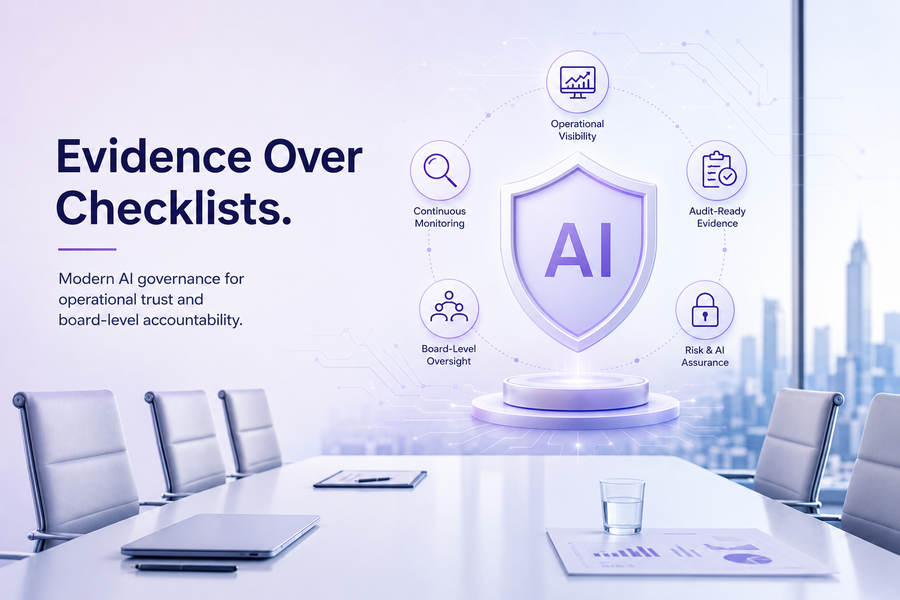
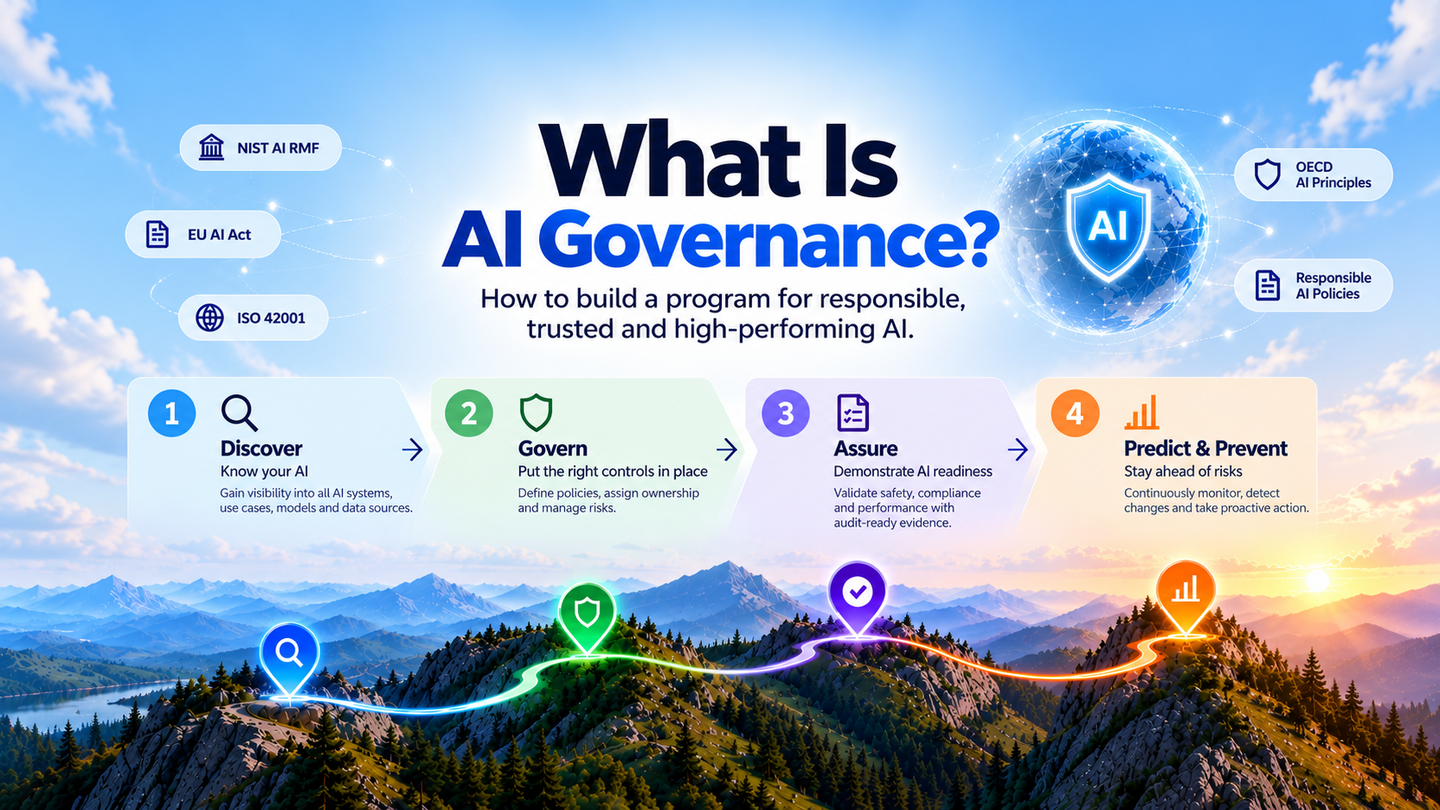
A practical guide to AI governance, risk management, AI assurance, regulatory alignment, and continuous oversight — from the first AI inventory to deployment readiness.
Artificial intelligence is becoming part of the infrastructure through which organizations operate, make decisions, and deliver services. Businesses are incorporating AI into customer interactions, software development, financial analysis, healthcare workflows, recruitment, and enterprise automation. Generative AI and AI agents are extending these capabilities, enabling systems to produce content, analyze information, interact with tools, and perform increasingly complex tasks.
Yet the ability to introduce AI is advancing faster than many organizations' ability to govern it consistently.
Business teams may adopt AI-enabled applications without a centralized review. Developers may integrate third-party models into products. Pilot projects may demonstrate promising results without establishing whether a system is ready for production. Policies may exist, but teams may lack the processes, technical controls, and evidence needed to demonstrate that those policies are being followed.
This creates a fundamental business challenge: How can an organization adopt AI at scale while maintaining visibility, accountability, control, and confidence in the systems it deploys?
AI governance provides the organizational structure for addressing this challenge. It establishes how AI systems are identified, assessed, approved, operated, and overseen. AI assurance complements governance by evaluating system behavior, validating relevant controls, and producing evidence to support decisions about readiness and ongoing use.
Together, these capabilities help organizations move beyond isolated policies and model evaluations toward a coordinated AI governance program.
This guide explains what AI governance means in practice, why it matters, how AI assurance fits into the picture, which frameworks organizations can use, and how to build a program that evolves with their AI adoption.
It also introduces CognitiveView's AI Governance Maturity Journey: Discover, Govern, Assure, and Predict & Prevent — a practical way to understand current capabilities and identify the next steps toward responsible AI deployment.
1. What Is AI Governance?
AI governance is the set of organizational structures, policies, responsibilities, processes, and controls used to direct and oversee how artificial intelligence is developed, acquired, deployed, used, and monitored.
It defines the conditions under which AI can be used, the responsibilities of the people involved, the risks that must be addressed, and the evidence required to support important decisions throughout an AI system's lifecycle.
AI governance applies to more than internally developed machine learning models. It can also cover:
- Generative AI applications and large language models.
- AI features embedded in enterprise software.
- Third-party AI products and services.
- AI agents that interact with applications, data, or business systems.
- Predictive models used in operational or business decisions.
- AI systems developed through external vendors or implementation partners.
- Experimental projects, pilots, and systems already operating in production.
The scope of governance should reflect the organization's activities, the intended use of each system, and the risks and obligations that apply.
An effective program establishes answers to six fundamental questions.
What AI are we using? The organization needs visibility into AI systems, applications, vendors, use cases, and dependencies.
Who is accountable? Each relevant use case needs appropriate ownership, decision-making authority, and responsibility for risks and outcomes.
What could go wrong? Risks must be evaluated in the context of the system's purpose, data, operating environment, and potential impact.
What safeguards are required? Policies must translate into practical controls, approval processes, technical safeguards, and human oversight.
How do we demonstrate readiness? Relevant evaluations, control checks, documentation, and evidence must support decisions about whether a system is suitable for its intended use.
How do we maintain oversight? The organization needs a way to identify changes, respond to incidents, review control effectiveness, and reassess systems when necessary.
These questions apply whether an organization is introducing its first AI application or managing a portfolio of AI systems across business units, vendors, and jurisdictions.
AI governance is more than an AI policy
An AI policy explains what an organization expects. A governance program establishes how those expectations are implemented and maintained.
For example, a policy might require AI systems that influence consequential decisions to undergo risk assessment and human review before deployment.
To make that requirement operational, the organization must define which systems are covered, how risk assessments are conducted, who reviews the results, what evidence is required, who approves deployment, and what happens when a requirement is not met.
Without these processes, a policy may express the right intention without ensuring consistent implementation.
A functioning governance program connects:
- People: accountable owners, decision-makers, and oversight functions.
- Processes: assessments, approvals, change management, and incident handling.
- Technology: inventories, controls, testing, monitoring, and workflow tools.
- Risk: identification, classification, mitigation, and acceptance.
- Evidence: documentation supporting assessments, control effectiveness, and decisions.
- Improvement: feedback, reassessment, remediation, and updates to the program.
AI governance therefore needs to be embedded into the way an organization operates, rather than treated solely as a documentation or compliance exercise.
2. Why Is AI Governance Important?
AI can create significant business value, but its risks are shaped by how it is designed, acquired, integrated, and used. A model's technical performance is only one part of the overall picture.
Organizations need governance because AI adoption can introduce uncertainty across technology, business operations, data, accountability, and regulatory obligations.
2.1 AI adoption can outpace organizational visibility
AI may enter an organization through formal development projects, software procurement, third-party services, or individual employee experimentation.
As a result, leadership may not have a complete picture of which systems are being used, what information they process, or which business activities depend on them.
This is particularly relevant when AI capabilities are embedded in applications that were purchased for other purposes.
Without a sufficiently complete inventory, organizations can struggle to assess exposure, assign ownership, and determine where additional safeguards are necessary.
AI discovery establishes the baseline from which governance decisions can be made.
2.2 AI risks are context-dependent
The same underlying technology can have very different implications depending on its application.
An AI system that summarizes public documents may require a different level of oversight from one that helps assess creditworthiness, supports clinical workflows, screens job applicants, or recommends actions affecting individuals.
Relevant risks may include inaccurate outputs, discrimination, inappropriate data use, security vulnerabilities, insufficient explainability, and overreliance on automated recommendations.
A risk-based governance program considers the intended purpose, affected stakeholders, operating environment, and potential consequences of failure. It then determines the safeguards and assurance activities appropriate to that context.
2.3 Technical success does not guarantee deployment readiness
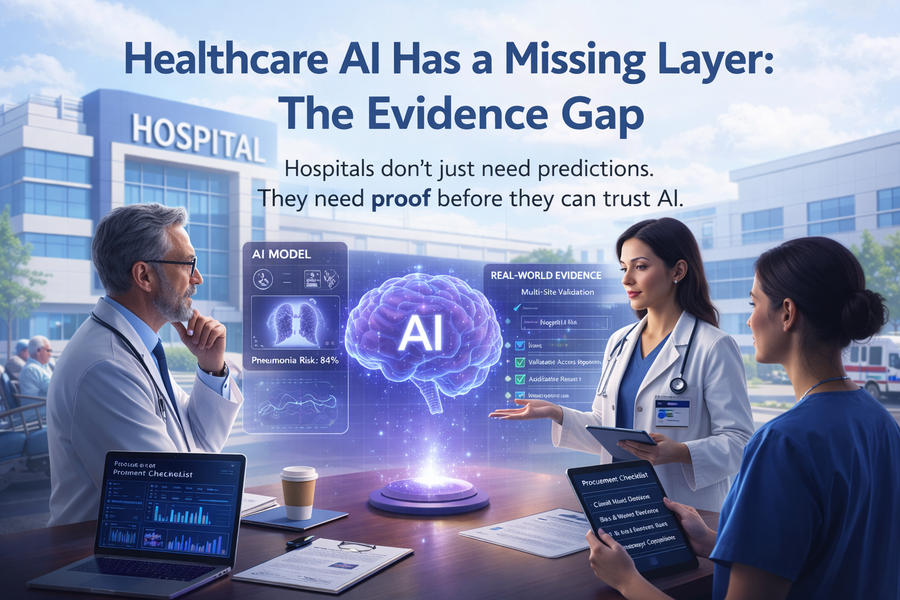
One of the most important distinctions in AI governance is the difference between a successful pilot and a system that is ready for operational deployment.
A pilot may show that a model produces useful outputs under controlled conditions. Production deployment introduces additional questions:
- Has the intended use been clearly defined and approved?
- Have relevant risks been assessed and treated?
- Are privacy and security requirements addressed?
- Has the system been evaluated under representative conditions?
- Are appropriate human oversight and escalation procedures in place?
- Is the organization able to explain and document the deployment decision?
- Can the system be monitored and reassessed after release?
A positive answer to the technical performance question does not automatically answer these operational and governance questions.
Deployment readiness requires an appropriate body of evidence, clear accountability, and a decision process that reflects the system's risks and applicable requirements.
2.4 Accountability must extend beyond the development team
AI outcomes are rarely the responsibility of a single function.
Business leaders define intended outcomes and acceptable risk. Developers and data scientists build and evaluate systems. Security and privacy teams address technical and data-related concerns. Legal, compliance, and risk functions help interpret obligations and review exposures.
Governance establishes how these responsibilities work together and who has authority to make or escalate decisions.
This is especially important when AI systems are acquired from vendors, integrated into existing workflows, or used by teams that did not develop the underlying models.
2.5 Organizations need evidence to support trust
Organizations may be asked to explain their AI practices to customers, procurement teams, auditors, regulators, partners, or internal risk committees.
Being able to demonstrate how a system was assessed, which controls were implemented, what limitations were identified, and who approved its use is more useful than relying on general assurances.
Evidence also helps organizations understand their own systems. It provides a record of what was evaluated, which issues remain unresolved, and what needs to be reviewed when the system changes.
2.6 AI oversight must continue after deployment
AI systems operate in changing environments. Models can be updated, data distributions can shift, integrations can change, and use cases can expand beyond their original scope.
A system that satisfied its initial requirements may need reassessment when these changes affect its risk profile.
Governance should therefore include defined monitoring responsibilities, incident processes, change triggers, and mechanisms for reviewing whether controls remain appropriate.
The objective is not to assume that every change creates a problem. It is to establish the ability to detect and address material changes in a timely and proportionate manner.
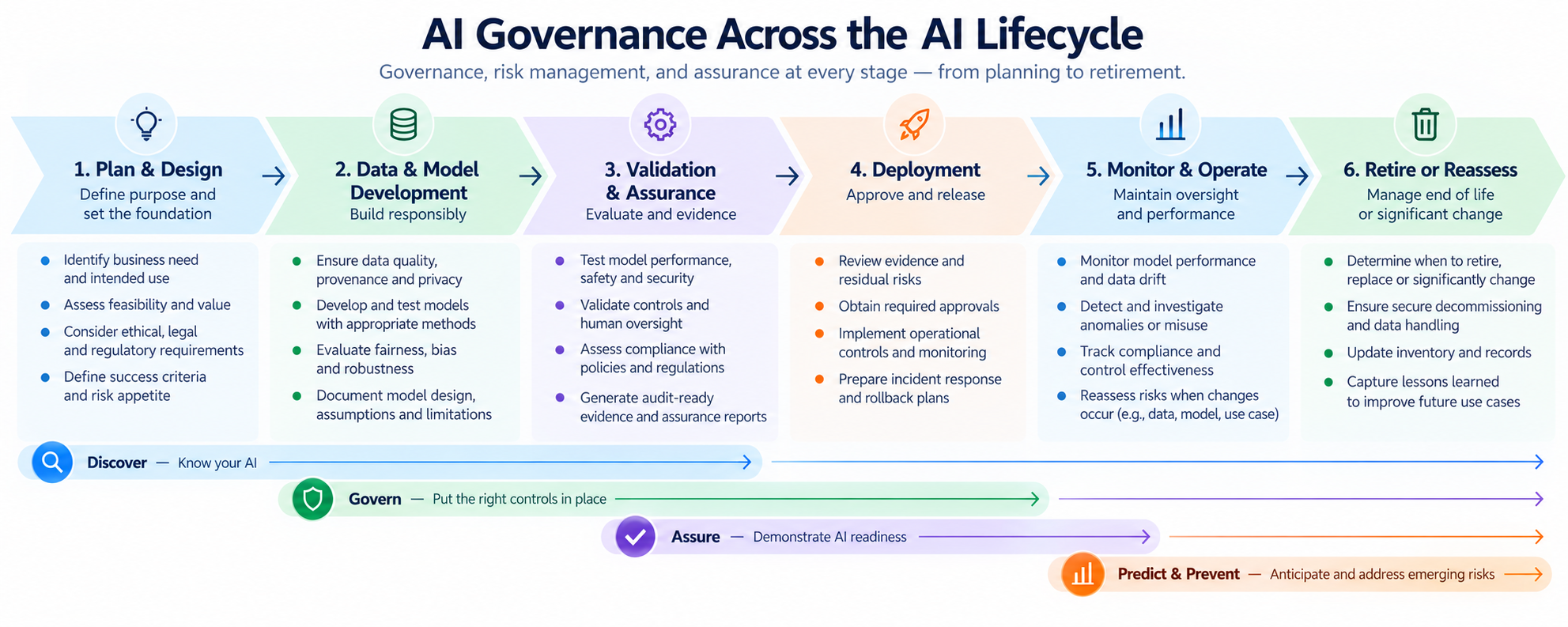
AI Governance Across the AI Lifecycle
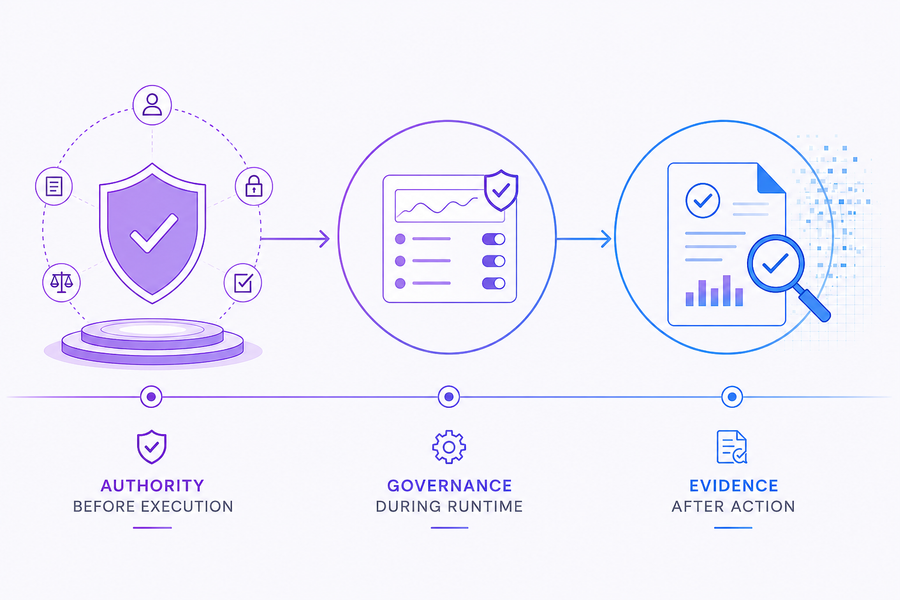
AI governance is not a one-time approval or a policy document created at the beginning of an AI project. It must operate throughout the AI lifecycle—from defining the use case and preparing data to validating the system, approving deployment, monitoring performance, and managing retirement.
Each stage introduces different risks, responsibilities, and evidence requirements. An AI system that performs well during testing may still require additional controls before deployment, while a system that was initially approved may need reassessment as its data, behaviour, intended use, or regulatory requirements change.
The lifecycle below illustrates where governance, risk management, and AI assurance should be embedded to support responsible and reliable AI adoption.
3. What Is the Difference Between AI Governance, AI Risk Management, AI Assurance, and AI Audit?
These terms are related, but they describe different parts of an effective program. Understanding the distinctions helps organizations avoid gaps and unnecessary duplication.
AI governance: establish direction and accountability
AI governance defines the policies, responsibilities, decision-making structures, and oversight processes for AI use.
It establishes what the organization expects, who is responsible, and how decisions should be made.
AI risk management: identify and treat risks
AI risk management focuses on understanding potential harms, evaluating their significance, determining appropriate mitigation, and managing residual risk.
It is an essential component of governance, helping organizations decide which safeguards are needed and where attention should be prioritized.
AI assurance: evaluate and demonstrate
AI assurance evaluates whether an AI system and its relevant controls meet defined requirements, using appropriate methods and evidence.
Depending on the use case, this may involve performance evaluation, safety testing, fairness assessment, security testing, control validation, documentation review, and analysis of limitations.
Assurance findings can inform deployment decisions, remediation plans, ongoing monitoring, and communications with relevant stakeholders.
AI audit: independently assess within a defined scope
An AI audit examines selected aspects of an AI system or governance program to determine whether specified requirements or criteria are satisfied.
An audit may assess the design and operation of controls, governance arrangements, documentation, or compliance processes. Independence, scope, methodology, and applicable standards depend on the audit context.
AI assurance and AI audit can overlap, but they should not be treated as interchangeable. An assurance assessment does not automatically constitute an independent audit.
Continuous monitoring: maintain oversight over time
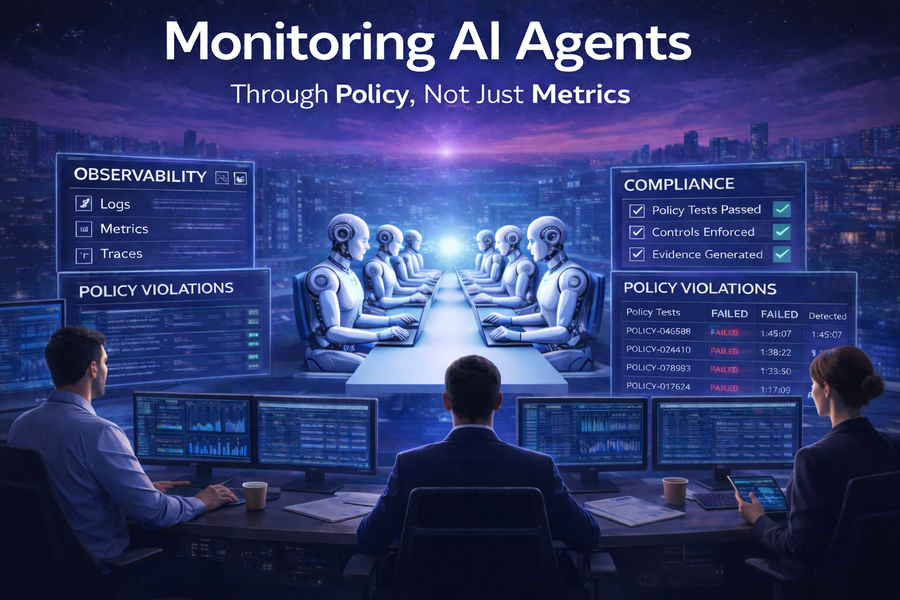
Continuous monitoring provides ongoing or recurring information about system behavior, risk indicators, and control effectiveness.
It helps organizations identify exceptions, investigate emerging issues, and determine when additional evaluation or governance action is required.
| Capability | Main question | Typical output |
|---|---|---|
| AI governance | Who is responsible, and what requirements apply? | Policies, ownership, approval workflows |
| AI risk management | What could go wrong, and how should risks be treated? | Risk assessments, mitigation plans, residual-risk decisions |
| AI assurance | What evidence demonstrates that requirements are met? | Evaluation results, findings, assurance records |
| AI audit | Have the defined criteria been independently assessed? | Audit findings and conclusions within scope |
| Continuous monitoring | What is changing, and what needs attention? | Monitoring records, alerts, exceptions, reassessment triggers |
These capabilities should work as a connected system. Governance establishes the requirements, risk management prioritizes the concerns, assurance evaluates the evidence, audit can independently examine selected controls or processes, and monitoring helps keep the program current.
The precise scope of each activity should be defined so that responsibilities, conclusions, and claims remain clear.
4. What Are the Key Components of an Effective AI Governance Program?
An effective AI governance program is not a single framework, committee, or software platform. It is an operating model that connects people, policies, risk assessments, technical controls, assurance activities, and ongoing oversight.
The components below can be implemented progressively. Their scope and depth should reflect the organization's AI footprint, the consequences of potential failures, and applicable obligations.
4.1 AI discovery and inventory management
The first requirement is visibility.
An organization cannot reliably manage AI risks if it does not know which systems are being used, where they operate, or what business processes depend on them.
An AI inventory should cover relevant systems across the lifecycle, including experimentation, development, testing, production, and retirement.
For each AI system, record:
- System name, description, and intended purpose.
- Business function and accountable owner.
- Technical owner and implementation status.
- Model provider, vendor, platform, and integrations.
- Data sources and categories of information processed.
- Users, affected stakeholders, and deployment environment.
- Initial risk classification and applicable requirements.
- Assessment status, approval records, and relevant evidence.
Discovery should include third-party applications with embedded AI capabilities, not just systems explicitly labelled as AI products.
Organizations should also establish procedures for updating the inventory when new systems are introduced, existing systems change, or applications are retired.
Expected outcome: A maintained record of AI use that supports risk prioritization, governance decisions, and assurance planning.
4.2 Policies, standards, and operating procedures
AI policies establish organizational expectations. Standards and procedures explain how those expectations are implemented.
A policy may prohibit entering confidential information into unauthorized AI tools. The corresponding operating process might define approved tools, access restrictions, data-handling requirements, employee training, exception approvals, and incident reporting.
A comprehensive program may include:
- Acceptable-use and responsible-AI policies.
- AI development and acquisition requirements.
- Risk assessment and classification procedures.
- Data governance and privacy requirements.
- Model testing and validation standards.
- Human oversight and approval procedures.
- Third-party AI assessment requirements.
- Change management and incident response.
- Documentation, evidence retention, and monitoring requirements.
Policies should be understandable to the people expected to follow them and sufficiently specific to support implementation.
They should also be reviewed as the organization's technology, risk profile, and obligations evolve.
Expected outcome: Consistent governance requirements that can be translated into operational controls and verifiable activities.
4.3 Roles, responsibilities, and decision rights
AI governance needs clear accountability across business and technical functions.
A central governance committee may establish policy and review significant risks, while individual business and technical owners remain responsible for their systems.
The organization should define who can:
- Propose and register an AI use case.
- Conduct and review risk assessments.
- Approve development, testing, and deployment.
- Accept residual risks within authorized limits.
- Require remediation or additional evaluation.
- Suspend or restrict a system when necessary.
- Review incidents and authorize corrective actions.
Decision rights are particularly important when a system presents unresolved risks. A team should know when it can proceed, when additional evidence is required, and when the decision must be escalated.
Expected outcome: Clear ownership and documented authority for AI-related decisions throughout the lifecycle.
4.4 AI risk assessment and treatment
Risk assessment determines what could go wrong, who or what could be affected, and which safeguards are appropriate.
The assessment should consider the intended use of the system rather than focusing solely on the underlying model.
Depending on the application, relevant dimensions may include:
- Accuracy, reliability, and robustness.
- Fairness, discrimination, and potential societal impact.
- Privacy, consent, and sensitive data exposure.
- Cybersecurity and adversarial manipulation.
- Hallucinations and unsupported outputs.
- Explainability, transparency, and accountability.
- Human oversight and inappropriate automation.
- Vendor dependencies and operational resilience.
- Legal, regulatory, and contractual exposure.
A risk assessment should identify the assumptions used, the evidence available, the limitations of the assessment, and the decisions that follow.
Organizations should also define how risks are classified, what mitigation is required, who can accept residual risk, and which findings prevent deployment until they are addressed.
Risk assessments should be revisited when material changes affect the system's purpose, data, capabilities, environment, or potential impact.
Expected outcome: A documented and actionable understanding of AI risks, with appropriate mitigation and escalation.
4.5 Data governance and model lifecycle management
AI systems depend on data, models, infrastructure, and external services. Governance must address these dependencies throughout the lifecycle.
Data governance may cover data quality, provenance, permissions, privacy, representativeness, retention, and access controls.
Model lifecycle management may cover:
- Defined objectives and acceptance criteria.
- Version control for models, code, and relevant datasets.
- Development and testing records.
- Evaluation of performance and known limitations.
- Security testing and dependency management.
- Change approval and release procedures.
- Deployment configuration and rollback arrangements.
- Maintenance, reassessment, and retirement.
For generative AI and agentic systems, organizations may also need controls for prompt injection, retrieval sources, sensitive data disclosure, tool permissions, action authorization, and the traceability of consequential interactions.
The level of control should reflect the system's context and potential consequences.
Expected outcome: Traceable development and deployment practices that support repeatable evaluation and controlled changes.
4.6 AI assurance and control validation
AI assurance is the component that connects governance requirements to evidence.
A requirement such as "the system must provide reliable outputs" needs a defined evaluation method, appropriate test conditions, measurable acceptance criteria where feasible, and documented results.
An assurance plan should establish:
- What system, version, and use case are being evaluated.
- Which requirements and risks are in scope.
- Which testing methods and evidence sources will be used.
- What constitutes an acceptable result.
- How limitations and failed tests will be handled.
- Who reviews the findings and makes the relevant decision.
- What conditions require reassessment after deployment.
Depending on the system, evaluation may include performance testing, fairness analysis, robustness testing, red teaming, privacy and security assessment, human-factors evaluation, and validation of operational controls.
Assurance should not be reduced to a single aggregate score. A high overall score can obscure a critical weakness in a dimension that matters for the intended use.
Results should therefore be interpreted against explicit requirements and risk tolerances, with significant limitations clearly documented.
Expected outcome: Evidence that supports informed decisions about AI suitability, unresolved risks, and required remediation.
4.7 Regulatory and framework alignment
Organizations need to understand which requirements apply to their activities and how those requirements translate into controls.
A regulatory and framework mapping should connect each relevant requirement to:
- The AI systems or activities in scope.
- The policy or control that addresses it.
- The person responsible for implementation.
- The evidence needed to demonstrate implementation.
- Any identified gaps and remediation actions.
- The process for reviewing changes in requirements.
Where multiple frameworks overlap, common controls can reduce duplication. However, organizations must preserve requirements that are unique to particular laws, standards, sectors, or use cases.
Framework alignment is not equivalent to certification or legal compliance. Those conclusions require the appropriate assessment against the applicable criteria.
Expected outcome: A traceable relationship between obligations, controls, owners, and supporting evidence.
4.8 Documentation, evidence, and audit trails
A governance program should preserve the information needed to understand what happened, why a decision was made, and what evidence supported it.
Relevant records may include AI system registrations, risk assessments, model documentation, testing results, approvals, exceptions, incidents, monitoring outputs, and remediation decisions.
For consequential AI use cases, organizations may also need to preserve relevant model versions, prompts, input context, retrieved sources, output records, or tool actions, subject to applicable privacy, security, retention, and proportionality requirements.
Evidence should be organized so that it can be traced to the system, requirement, control, evaluation, or decision it supports.
Expected outcome: A defensible and retrievable record of governance and assurance activities.
4.9 Continuous monitoring and improvement
Governance must remain relevant after deployment.
Organizations should define what needs to be monitored, what constitutes a significant exception, who investigates it, and when corrective action or reassessment is required.
Depending on the application, monitoring may include:
- Model performance and data drift.
- Output quality and reliability.
- Safety and policy violations.
- Security events and unusual interactions.
- Control failures and overdue remediation.
- Changes to models, data, vendors, and integrations.
- Incidents and complaints from affected stakeholders.
Monitoring should be proportionate to risk. Not every AI application requires identical monitoring frequency or depth.
The results should feed back into risk assessments, assurance plans, policies, and governance decisions.
Expected outcome: An ongoing process for detecting relevant changes, addressing issues, and improving the program.
5. Which AI Governance Frameworks and Standards Should You Consider?
Frameworks help organizations structure their approach to AI governance, but they serve different purposes. Selecting a framework should begin with the organization's objectives and obligations, rather than simply adopting the most widely discussed standard.
NIST AI Risk Management Framework
The NIST AI Risk Management Framework provides a voluntary approach to identifying and managing AI risks.
Its four functions are:
- Govern: Establish organizational responsibilities, policies, and risk management practices.
- Map: Understand the context, intended use, and potential impacts of AI systems.
- Measure: Evaluate risks and relevant trustworthiness characteristics.
- Manage: Prioritize risks and determine appropriate responses.
The framework can help organizations connect governance responsibilities with system-level assessment and risk treatment. NIST describes these functions as applicable across the AI lifecycle, with governance informing the other activities.
Official resource: NIST AI Risk Management Framework.
ISO/IEC 42001
ISO/IEC 42001 specifies requirements for establishing, implementing, maintaining, and continually improving an AI management system.
It can help organizations formalize responsibilities, management processes, risk treatment, operational controls, and continual improvement.
Organizations seeking certification should distinguish between implementing the standard's requirements, undergoing a certification process, and making claims about particular AI systems. An AI management system certificate does not automatically certify every model or use case as safe or suitable for deployment.
Official resource: ISO/IEC 42001.
EU AI Act
The EU AI Act establishes legal obligations for relevant AI systems and actors within its scope. Its requirements vary according to factors including the system, its intended use, and the role of the organization.
Organizations should determine whether they act as providers, deployers, or in another relevant capacity, and identify the obligations applicable to their circumstances.
The European Commission's published implementation timeline identifies 2 August 2026 as a major application milestone, while additional provisions have separate timelines and transition arrangements. Organizations should consult the current official timeline and applicable legal advice rather than assume that every requirement applies on the same date.
Official resource: European Commission — EU AI Act implementation timeline.
OECD AI Principles
The OECD AI Principles provide high-level principles for trustworthy AI, including considerations around human-centred values, transparency, robustness, security, safety, and accountability.
They can help inform organizational AI principles and responsible-use policies. They do not replace applicable legislation or the operational controls needed to implement those principles.
Official resource: OECD AI Principles.
How should these frameworks work together?
Organizations do not necessarily need to choose only one framework.
For example, an organization may use NIST AI RMF to structure risk management, ISO/IEC 42001 to establish its management system, and applicable legal requirements to identify mandatory obligations.
The important step is to map the requirements into a coherent operating model.
Rather than maintaining disconnected documentation for each framework, organizations can identify common controls, assign owners, and link each requirement to appropriate evidence. Requirements that are unique to a particular law or standard should remain explicitly identified.
This approach can reduce duplication while preserving the distinctions between voluntary guidance, management-system standards, certification, and binding legal obligations.
6. How Do You Assess AI Governance Maturity?
AI governance maturity describes how consistently an organization can identify AI systems, manage their risks, implement appropriate controls, demonstrate assurance, and maintain oversight.
Maturity is not determined by the number of policies an organization has written or the number of AI systems it has assessed. It depends on whether the organization can apply governance practices consistently, demonstrate that they are working, and respond when conditions change.
An organization may have established cybersecurity and compliance processes but lack an enterprise-wide AI inventory. Another may have sophisticated model testing capabilities but no consistent deployment approval process.
Both need to understand their existing strengths and gaps before deciding what to improve.
CognitiveView's four-stage AI Governance Maturity Journey
CognitiveView uses four stages to help organizations understand their progress toward responsible AI deployment.
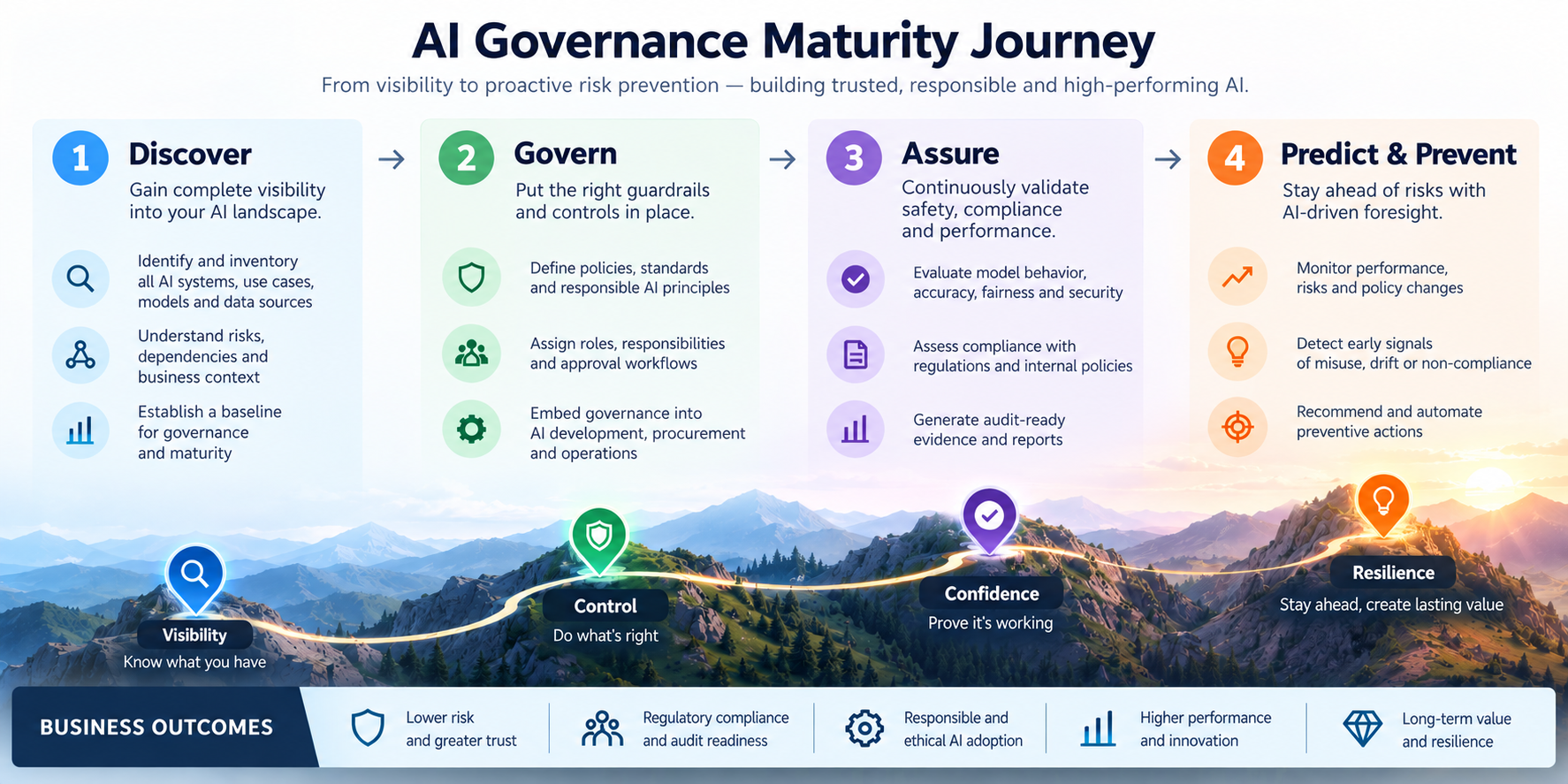
Stage 1: Discover — Know your AI
The central question: Where is AI being used?
The Discover stage establishes visibility into AI applications, models, agents, vendors, data dependencies, and business use cases.
Organizations at this stage focus on identifying what exists, who owns it, how it is used, and which systems require further assessment.
Typical activities include:
- Creating an AI system and application inventory.
- Identifying third-party and embedded AI capabilities.
- Discovering unapproved or undocumented AI usage.
- Mapping AI systems to business functions and owners.
- Recording lifecycle status, data dependencies, and relevant vendors.
- Identifying systems that require risk classification or additional review.
Maturity outcome: The organization has a usable baseline of its AI landscape and can identify where governance attention is required.
Discovery is foundational, but it does not establish that identified systems are appropriately governed or ready for deployment.
Stage 2: Govern — Put the right controls in place
The central question: Are the right controls and accountability arrangements in place?
The Govern stage establishes the organizational processes that direct AI use.
This includes policies, ownership, risk assessments, approval workflows, human oversight, and requirements for managing third-party AI.
Typical activities include:
- Assigning business and technical owners.
- Establishing AI policies and operational procedures.
- Defining risk classifications and risk acceptance criteria.
- Mapping applicable frameworks and regulatory obligations.
- Establishing approval, escalation, and incident management processes.
- Implementing appropriate technical and operational controls.
- Maintaining documentation of decisions and remediation actions.
Maturity outcome: AI use is managed through defined processes, with clear responsibilities and controls proportionate to the relevant risks.
Governance establishes the conditions for responsible AI use. It does not, by itself, prove that a system performs as intended.
Stage 3: Assure — Demonstrate AI readiness
The central question: Can we demonstrate that our AI systems meet their requirements?
The Assure stage evaluates whether AI systems and their relevant controls meet defined requirements and whether the available evidence supports the intended deployment decision.
It connects governance requirements with evaluation, validation, documentation, and review.
Typical activities include:
- Defining acceptance criteria for each relevant use case.
- Evaluating accuracy, reliability, safety, fairness, and other relevant characteristics.
- Testing for application-specific security and operational risks.
- Validating that required controls are implemented.
- Documenting evaluation results, limitations, and unresolved risks.
- Producing structured assurance records and reports.
- Supporting decisions to proceed, proceed with conditions, or undertake further remediation.
Maturity outcome: The organization can explain what was evaluated, what the results demonstrate, what limitations remain, and how the findings inform deployment decisions.
This stage is where the distinction between a promising pilot and a governed production deployment becomes especially important.
A system may demonstrate strong technical performance yet remain unsuitable for a particular deployment because of unresolved risks, insufficient controls, missing approvals, or inadequate operational readiness.
Stage 4: Predict & Prevent — Anticipate and address emerging risks
The central question: Can we identify and address issues as our AI systems evolve?
The Predict & Prevent stage extends oversight beyond initial assessment and approval.
Organizations establish ongoing monitoring and reassessment processes to detect relevant changes, investigate exceptions, and respond before issues escalate where practicable.
Typical activities include:
- Monitoring relevant performance and risk indicators.
- Detecting changes in model behavior and data.
- Reviewing control effectiveness and exceptions.
- Reassessing systems after material changes.
- Automating alerts and remediation workflows where appropriate.
- Incorporating incident findings and feedback into governance.
- Maintaining traceable evidence of ongoing oversight.
Maturity outcome: The organization has an ongoing process for identifying emerging risks, maintaining appropriate controls, and improving assurance over time.
Continuous monitoring does not guarantee that every issue will be detected or prevented. It improves the organization's ability to identify relevant changes and respond systematically.
Why the four stages should not be treated as a simple score
An organization may be advanced in one capability and immature in another.
For example, it may have strong AI evaluation practices but no reliable inventory of third-party AI applications. It may have formal policies but no evidence that controls are operating effectively.
A useful maturity assessment therefore examines multiple dimensions, including discovery, accountability, risk management, compliance, assurance, evidence, and monitoring.
The objective is to identify the gaps that matter most, not simply to assign an overall label.
7. How Do You Build an AI Governance and Assurance Program?
Once the organization understands its current maturity, it needs an implementation plan that translates the findings into operational improvements.
The following six-step approach provides a practical starting point.
Step 1: Establish a baseline of AI use
Begin by identifying the AI systems the organization develops, purchases, integrates, and uses.
Engage business teams, engineering, IT, procurement, security, legal, and compliance to identify systems that may not appear in formal technology inventories.
For each system, record its intended purpose, owner, lifecycle status, dependencies, and initial risk considerations.
Prioritize improving visibility where AI usage is undocumented or where the potential consequences of failure are significant.
Deliverables:
- Initial AI inventory.
- Identified ownership gaps.
- Preliminary risk classifications.
- List of systems requiring further review.
Step 2: Establish the governance operating model
Define the program owner, decision-making structure, and responsibilities across relevant functions.
Establish the policies and procedures required to register, assess, approve, operate, and retire AI systems.
Determine which decisions can be made by system owners and which require review or escalation. Define how residual risks are accepted and documented.
Select the relevant frameworks and identify the legal, contractual, and sector-specific requirements that need to be addressed.
Deliverables:
- Governance operating model.
- Responsibility and decision-rights matrix.
- Initial policy and procedure set.
- Requirements and framework mapping.
Step 3: Assess risks and prioritize gaps
Conduct structured assessments of relevant AI use cases.
Consider the system's intended purpose, affected stakeholders, data, technical characteristics, operating environment, and potential consequences of failure.
Identify missing controls, incomplete documentation, insufficient testing, unclear ownership, and other gaps.
Prioritize remediation according to risk, applicable obligations, business impact, and dependencies.
Deliverables:
- AI risk assessments.
- Risk and gap register.
- Prioritized remediation roadmap.
- Named owners and target dates.
Step 4: Define controls and assurance requirements
Translate the identified risks and governance requirements into specific controls and evaluation criteria.
For each relevant system, determine what must be demonstrated before deployment, which tests and reviews are required, what evidence must be retained, and who is authorized to make the decision.
For example, a generative AI application may require evaluation of factual accuracy, harmful outputs, prompt injection, and sensitive data exposure. A predictive model used in a consequential decision may require different performance, fairness, and human-oversight evaluations.
The assessment should reflect the intended use rather than rely on a universal testing template.
Deliverables:
- Control requirements.
- Assurance and evaluation plans.
- Acceptance criteria.
- Evidence requirements and approval workflows.
Step 5: Evaluate systems and make evidence-based decisions
Conduct the required evaluations and review the results against defined criteria.
Document findings, limitations, failed tests, unresolved risks, and remediation actions. Ensure that decision-makers can understand what the evidence demonstrates and what it does not.
Possible outcomes may include:
- Proceeding with deployment when applicable requirements are met and the authorized decision-maker approves.
- Proceeding with defined conditions where permitted and supported by the organization's risk process.
- Requiring remediation and further evaluation before deployment.
- Rejecting or discontinuing a proposed use where the risks cannot be acceptably addressed.
These are governance decision options, not universal regulatory labels.
The decision should be traceable to the system, intended use, evidence, applicable requirements, and authorized approval.
Deliverables:
- Evaluation results and assurance records.
- Documented findings and limitations.
- Remediation and retesting records.
- Deployment decision and supporting evidence.
Step 6: Monitor, reassess, and improve
After deployment, define the monitoring responsibilities, relevant indicators, incident processes, and triggers for reassessment.
Review whether controls remain effective and whether changes to the model, data, integrations, or intended use affect the original risk assessment.
Use the results to improve governance policies, testing methods, control design, and remediation priorities.
Deliverables:
- Monitoring and escalation procedures.
- Exception and incident records.
- Reassessment triggers.
- Ongoing remediation and improvement plans.
The implementation should be phased according to risk and existing capabilities. A lower-risk internal application may require a lighter process than an AI system supporting consequential decisions, subject to applicable obligations.
8. Who Should Be Responsible for AI Governance?
AI governance requires coordination across the organization, but shared responsibility should not mean unclear accountability.
A practical model establishes executive sponsorship, a program owner, cross-functional participation, and named owners for individual AI systems.
| Role | Primary responsibility |
|---|---|
| Executive leadership | Establish direction, accountability, and resources |
| AI governance lead or committee | Coordinate governance processes and significant decisions |
| Business owner | Define intended use, business outcomes, and operational responsibility |
| AI or technical owner | Maintain the system, its documentation, and technical controls |
| Data science and engineering | Develop, test, validate, and maintain AI systems |
| Security and privacy | Address cybersecurity, access, data protection, and privacy risks |
| Legal and compliance | Interpret applicable obligations and advise on regulatory exposure |
| Risk management | Support risk assessment, treatment, and escalation |
| Internal audit | Independently assess relevant governance and controls within its mandate |
The precise structure will depend on the organization's size and complexity.
A smaller organization may start with one accountable program owner and a cross-functional group. A larger enterprise may require a formal governance committee, defined risk tiers, and regional or business-unit implementation.
In either case, decision rights should be documented, and the people accountable for AI outcomes should have the authority to respond when requirements are not met.
9. How Should You Measure AI Governance Effectiveness?
An AI governance program should be measured by the quality and effectiveness of its operation, not just by the number of policies or assessments completed.
Useful indicators include the following.
| Dimension | Example measure | What it helps reveal |
|---|---|---|
| AI discovery | Coverage of identified AI systems in the inventory | Whether the organization has visibility into AI use |
| Accountability | Proportion of relevant systems with assigned owners | Whether responsibility is clear |
| Risk management | Coverage of required risk assessments | Whether systems are being reviewed appropriately |
| Control effectiveness | Findings and remediation status for important controls | Whether safeguards work as intended |
| Assurance | Proportion of in-scope systems with completed evaluations and documented decisions | Whether deployment decisions are evidence-based |
| Remediation | Age and status of significant outstanding findings | Whether identified problems are being addressed |
| Monitoring | Time to detect, investigate, and resolve relevant exceptions | Whether oversight supports timely action |
| Improvement | Progress against governance action plans and recurring issue trends | Whether the program is becoming more effective |
Metrics should be interpreted in context.
For example, a high assessment-completion rate does not establish that assessments are thorough or that identified risks have been adequately treated. A low incident count does not prove that a system is safe.
A useful measurement program combines coverage, control effectiveness, evidence quality, remediation progress, and operational outcomes.
Organizations should also avoid treating a single maturity score as a substitute for understanding critical gaps. A serious weakness in one area may matter more than strong performance across several lower-risk areas.
10. Common Mistakes to Avoid When Building an AI Governance Program
Mistake 1: Treating governance as a documentation exercise
Publishing policies is not enough. Requirements must be implemented through assigned responsibilities, operational procedures, controls, and evidence.
Mistake 2: Assuming the AI inventory is complete
AI tools and capabilities can enter through existing software, vendors, and individual teams. Discovery should be maintained rather than treated as a one-time activity.
Mistake 3: Applying identical controls to every AI system
Governance should reflect the system's purpose, potential impact, and applicable obligations. Excessive controls can create unnecessary friction, while insufficient controls can leave significant risks unaddressed.
Mistake 4: Equating a successful pilot with deployment readiness
Technical performance is only one consideration. Deployment decisions also depend on relevant risks, safeguards, approvals, operational readiness, and evidence.
Mistake 5: Confusing framework alignment with compliance or assurance
A framework mapping can help organize governance activities, but it does not automatically demonstrate legal compliance, certification, or that an AI system meets its requirements.
Mistake 6: Conducting assessments without resolving findings
Assessments are useful only when the organization determines what the findings mean, assigns remediation where necessary, and documents the resulting decisions.
Mistake 7: Stopping governance after deployment
AI systems and their operating environments can change. Organizations need defined monitoring and reassessment processes to maintain appropriate oversight.
Mistake 8: Treating monitoring as a substitute for governance
Monitoring may identify a problem, but an effective program also needs clear responsibility, escalation, investigation, remediation, and decision-making authority.
Avoiding these mistakes helps organizations build a program that operates in practice rather than one that exists primarily on paper.
11. How CognitiveView Supports AI Governance and Assurance
CognitiveView brings AI discovery, governance, risk management, assurance, and ongoing oversight together to support organizations throughout their AI governance journey.
Its approach connects governance foundations with the evaluation and evidence needed to make informed decisions about AI systems.
AI discovery and inventory
Support visibility into AI assets, applications, and use cases, creating a foundation for risk assessment and governance.
Governance and risk management
Organize AI risk assessments, policies, compliance requirements, controls, and governance workflows.
AI assurance with TRACE-RAI
Support structured AI evaluation and the generation of audit-ready evidence. TRACE-RAI is designed to help organizations connect evaluation results with assurance reporting and documented readiness decisions.
Continuous control monitoring
Support ongoing oversight of relevant controls and the identification of exceptions that may require attention.
AI TrustCenter
Organize and share appropriate governance and assurance information with customers, procurement teams, and other stakeholders.
Framework alignment and professional services
CognitiveView supports governance activities aligned with frameworks such as NIST AI RMF, ISO/IEC 42001, and the EU AI Act, depending on the requirements and implementation.
Professional services can help organizations establish governance foundations, assess readiness, implement frameworks, integrate workflows, and train teams.
The objective is to connect AI systems, risk assessments, controls, evaluation results, evidence, and governance decisions in a more consistent operating model.
The appropriate scope depends on the organization's current maturity, technology environment, use cases, and applicable obligations.
12. Frequently Asked Questions About AI Governance
What is an AI governance program?
An AI governance program is the organized set of responsibilities, policies, procedures, controls, and oversight activities used to manage AI responsibly. It typically includes AI discovery, risk management, accountability, regulatory alignment, assurance, documentation, and ongoing monitoring.
What is the difference between AI governance and AI compliance?
AI compliance focuses on meeting applicable legal, regulatory, contractual, or standards-based requirements. AI governance is broader: it establishes how an organization makes decisions about AI, assigns responsibility, manages risk, and maintains oversight. Compliance is an important component of governance.
What is AI assurance, and why is it important?
AI assurance evaluates whether an AI system and relevant controls meet defined requirements, using appropriate evidence. It helps organizations identify limitations, support deployment decisions, document findings, and demonstrate how risks and controls have been assessed.
Is AI assurance the same as AI auditing?
No. AI assurance is a broad set of evaluation and evidence activities. An AI audit examines specified criteria and controls within a defined scope, with independence and methodology determined by the audit context. Assurance does not automatically imply an independent audit.
Which AI governance framework should an organization use?
The appropriate framework depends on the organization's objectives, industry, jurisdictions, and AI use cases. NIST AI RMF provides a risk management framework, ISO/IEC 42001 specifies AI management system requirements, and the EU AI Act establishes legal obligations for relevant AI systems and actors within its scope.
How long does it take to implement an AI governance program?
The timeline depends on organizational complexity, existing governance capabilities, the number and types of AI systems, and applicable requirements. Organizations can begin by establishing visibility, assigning ownership, and prioritizing important gaps, then implement more extensive controls and assurance processes progressively.
Does an AI governance program guarantee that AI is safe?
No. Governance and assurance cannot eliminate every risk. They help organizations identify relevant risks, implement safeguards, evaluate system behavior, document limitations, and maintain oversight. Their effectiveness depends on the quality of implementation and ongoing improvement.
How often should AI systems be reassessed?
Organizations should establish review schedules proportionate to risk and reassess when material changes occur. Examples include changes to intended use, models, data sources, integrations, operating conditions, or applicable requirements, as well as significant incidents.
How can an organization assess its AI governance readiness?
A readiness assessment should review AI discovery, data governance, model development and deployment, governance and risk management, regulatory alignment, ethics and transparency, and ongoing improvement.
CognitiveView's AI Governance Readiness Checklist provides a structured starting point for identifying gaps and prioritizing improvements.
13. Start Building Your AI Governance and Assurance Program
Responsible AI adoption requires more than technical capability or a set of documented policies. Organizations need visibility into their AI systems, clear accountability, appropriate safeguards, evidence that supports deployment decisions, and a process for maintaining oversight as systems evolve.
AI governance establishes the operating structure. Risk management helps determine what needs attention. AI assurance connects requirements to evidence. Continuous monitoring supports ongoing oversight and improvement.
CognitiveView's four-stage journey — Discover, Govern, Assure, and Predict & Prevent — provides a practical way to understand these capabilities and identify the next steps toward responsible AI deployment.
Take the first step: assess your AI governance readiness
Download the CognitiveView AI Governance Readiness Checklist to review your current practices across:
- AI discovery and inventory.
- Data governance and management.
- Model development and deployment.
- Governance and risk management.
- Regulatory and compliance alignment.
- Ethics, fairness, and transparency.
- Ongoing improvement and organizational culture.
Use the assessment to identify gaps, assign ownership, prioritize higher-risk issues, and develop a practical improvement roadmap.
Download the AI Governance Readiness Checklist
To explore how CognitiveView supports AI governance, assurance, and ongoing oversight, visit cognitiveview.com or contact sales@cognitiveview.com.
Govern with confidence. Build with responsibility. Scale with trust.